Hart Mill (also known as the Hart Brothers Mill or Hart Flour Mill) was a prominent 19th–early 20th century grain mill in Flushing, Michigan. It was the last in a succession of mills built at the same site along the Flint River, a site that had housed Flushing’s mills since the community’s founding. Rebuilt by the Hart family in 1876, this mill became an economic hub for the village – processing local farmers’ grain and even generating the town’s first electricity – until it was destroyed by a disastrous fire on March 19, 1918, which brought an end to over eight decades of milling tradition in Flushing
Origins and Early Mills in Flushing
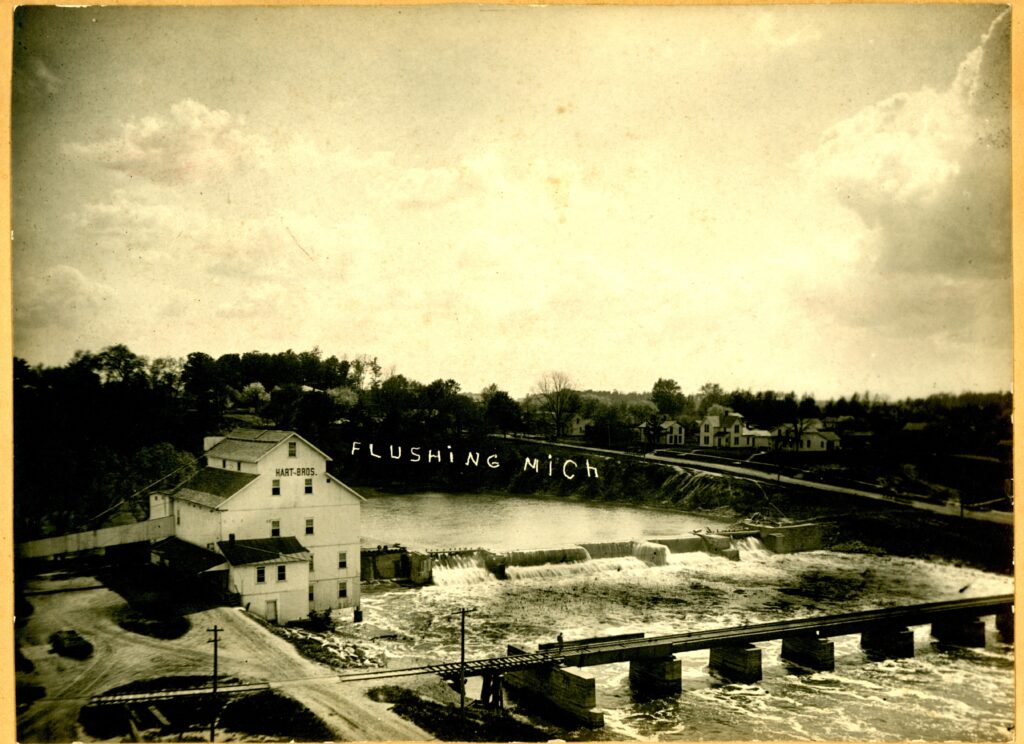
Flushing began as a mill town in the 1830s, when early settlers were drawn by the water power of the Flint River. The area’s first sawmill was established in 1836 by Thomas L. L. Brent, a Virginian entrepreneur who dammed the river and erected Flushing’s initial mill. This pioneer mill was short-lived – its dam was washed out by a flood in 1837 – but it marked the start of Flushing’s milling industry. Subsequently, new mills were built along the river, taking advantage of the ample water power and supporting the region’s growing agricultural community
In the mid-19th century, grain milling became central to Flushing’s economy. At least two successive mills operated at the Main Street riverfront site south of the bridge – processing wheat and other local crops – but both were lost to devastating fires, a common hazard for wooden mills of that era. Each time, the mill was rebuilt, underscoring the site’s importance. In 1876, the mill was completely reconstructed by the Hart family – a local family of millers – giving rise to the name “Hart Brothers Mill.” A historic photograph from the Flushing Area Historical Society is captioned “Hart Bros Mill – Rebuilt 1876,” indicating that year as the date of the Hart-led reconstruction. This rebuilt Hart Mill was a large, water-powered flour mill located just south of Flushing’s Main Street bridge, roughly on the spot later occupied by a car wash and the Tucker swimming pool.
Heyday of the Hart Mill (Late 1800s)
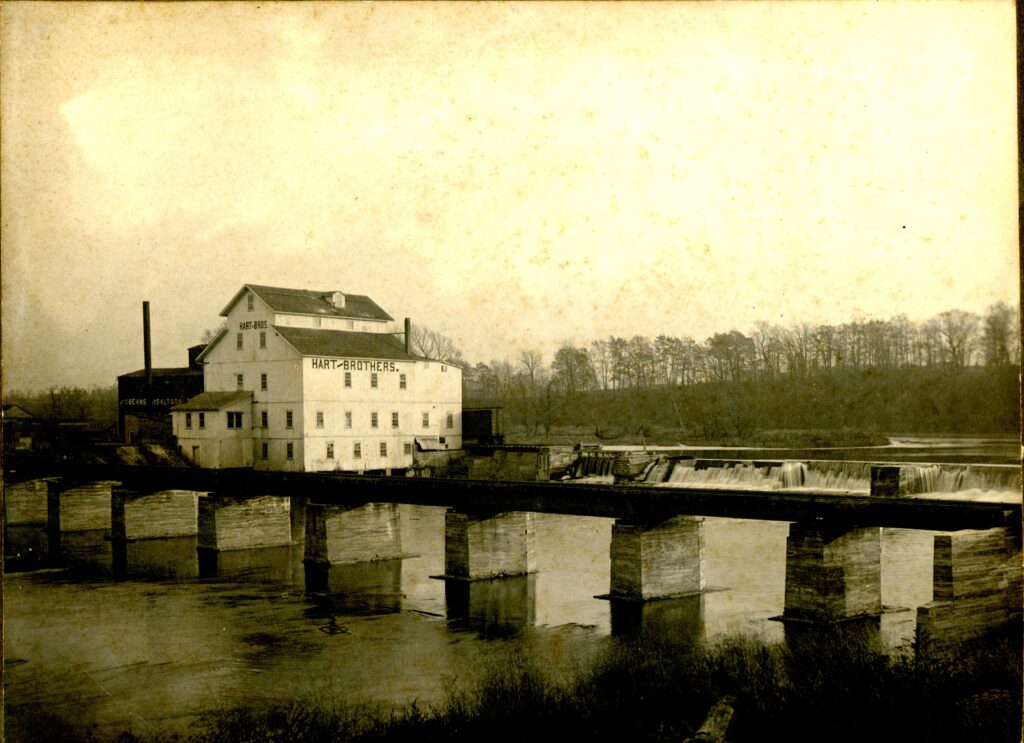
Under the Hart Brothers’ ownership, the mill thrived as a focal point for local agriculture and commerce. Farmers from Flushing and surrounding Genesee County brought wheat and other grains to be ground into flour at the mill, which in turn helped feed the growing community. The mill’s success even influenced transportation infrastructure: the Toledo & Ann Arbor Railroad’s arrival in Flushing in 1888 included a special spur line to the mill. On February 7, 1889, a locomotive crossed the Flint River for the first time specifically to service the Hart & Clark Mill, reflecting how critical the mill was in regional trade. (At that time, the mill was operated in partnership between the Hart family and a local associate named Clark, hence the name “Hart & Clark Mill.”) This rail connection greatly improved distribution of the mill’s flour and bolstered Flushing’s prominence as a market town in the late 19th century.
During its heyday, the Hart Mill also endured natural challenges. Notably, a major Flint River flood in 1904 swamped the riverside facility – an event documented by period photographs of the mill surrounded by floodwaters. Despite such challenges, the sturdily built 1876 Hart Mill continued operating into the new century, adapting to the times.
Role in the Community and Technological Significance
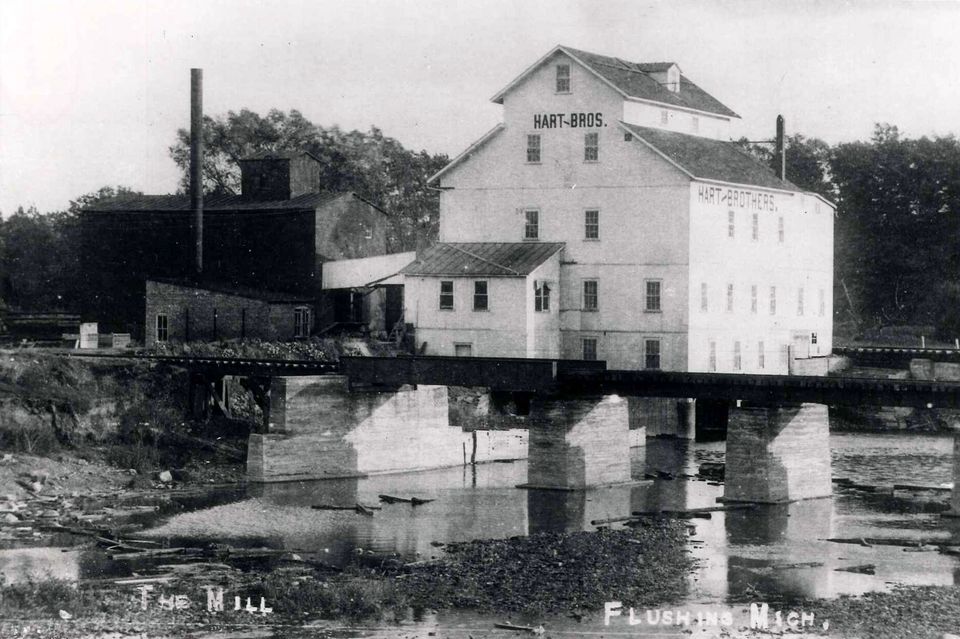
Beyond its primary function as a gristmill, the Hart Mill played an innovative role in Flushing’s early modernization. By the 1890s–1900s, the mill was harnessed to generate electric power for the village. In an era before a dedicated power plant existed, the water-driven mechanisms of the mill were used to run dynamos, supplying electricity for lighting in Flushing. This made Hart Mill effectively the community’s first electric power source – a point of civic pride and a critical utility for local homes and businesses during the early 20th century.
The mill’s towering structure and riverside dam were a defining feature of downtown Flushing’s landscape. It was often photographed and featured on postcards – for example, an old 1916 postcard proudly depicted the Hart Mill as an iconic scene of the village. By that time, it was already noted as “the last of the older mills” along the Flint River in Flushing, as newer industrial methods were emerging and other historic mills had disappeared.
Destruction of the Mill (1918) and Aftermath
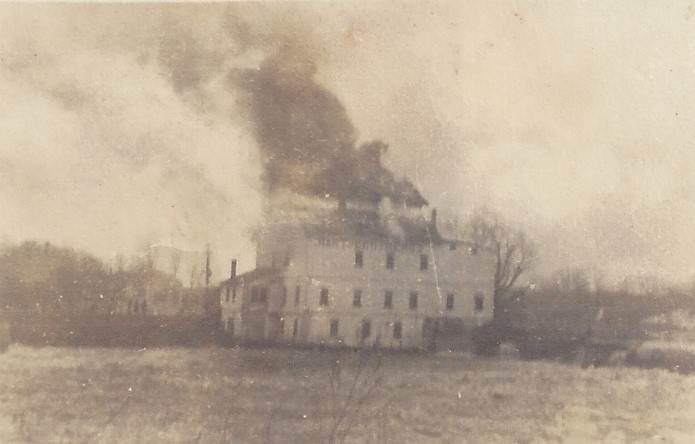
Tragically, the Hart Flour Mill met the same fate as its predecessors. On March 19, 1918, a catastrophic fire broke out and burned the mill to the ground. This blaze was the third conflagration to strike a mill on that site, and it destroyed what would be the final iteration of Flushing’s historic mill. At the time of its destruction, the mill’s importance was such that the fire had immediate, far-reaching effects on local life. Electric service to Flushing was lost when the mill’s generators were ruined – plunging the village into darkness for 14 months until a new power plant could be built in 1919. The loss of the Hart Mill marked the end of an era: no further grist mills were built on the site after 1918, as modern electric mills and industrial facilities elsewhere took over grain processing for the region.
In the years following the fire, the charred remains of the mill were cleared, and Flushing gradually moved on from its milling heritage. By the mid-20th century, the once-bustling mill site had been repurposed for other uses. Today, no part of the old Hart Mill stands; the area near the Main Street bridge where it once operated later became home to local businesses (like a car wash and the former Tucker swimming pool) rather than industrial mills. What does endure is the legacy of Hart Mill in Flushing’s history – as a symbol of the city’s pioneer origins, its agricultural prosperity, and its early technological progress
Each of these milestones illustrates the central role of Hart Mill in Flushing’s history. From its early days as part of the town’s founding industry, through periods of rebuilding and technological innovation, to its dramatic destruction, Hart Mill’s story encapsulates the rise and fall of Flushing’s mill town heritage. The mill not only boosted local agriculture and commerce during the 19th century, but it also symbolized the community’s adaptability – even serving as an electrical powerhouse for the city in the early 1900s. Its fiery demise in 1918 was a turning point; after that, Flushing transitioned away from water-powered industry. The memory of Hart Mill, however, lives on through photographs, local histories, and the lasting impact of those early enterprises on Flushing’s development and identity.