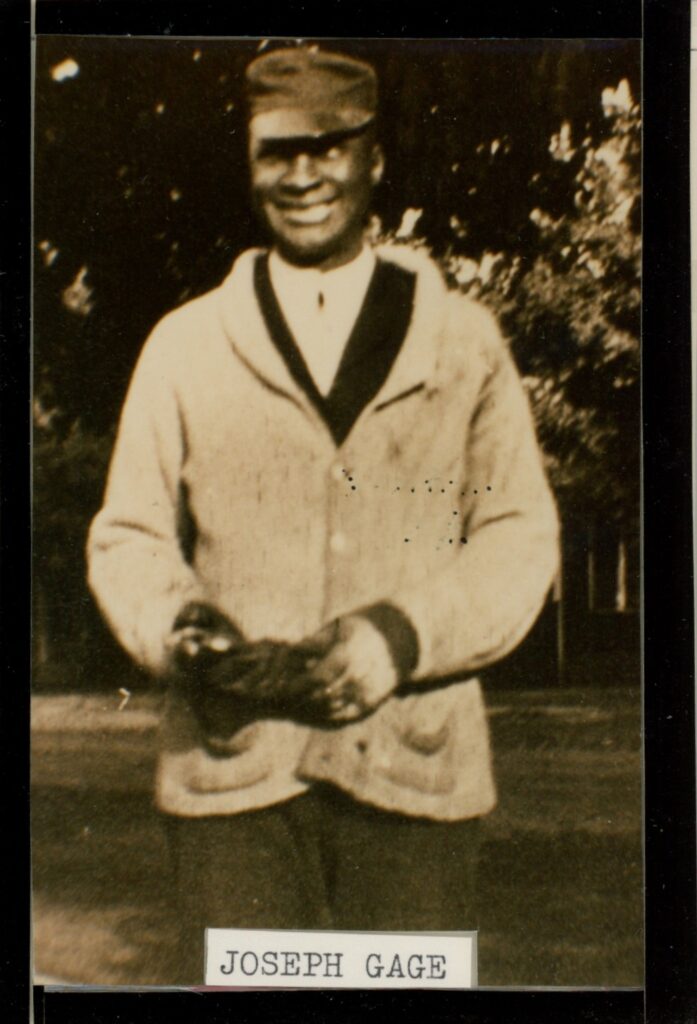
(born April 10, 1866 – died March 6, 1956) was an African-American trailblazer who broke racial barriers in small-town Michigan. He was among the first Black residents of both Ithaca (Gratiot County) and Flushing (Genesee County), where he became a beloved figure serving as a barber, boxer, firefighter (the first Black member of each town’s fire department), and eventually Fire Chief in Flushing. Gage also held civic leadership roles – at one point acting as president of Flushing’s Village Board of Commerce – in an era when such achievements by an African-American were virtually unheard of. Renowned for his integrity, energy, and community spirit, Joe Gage was honored in his later years with massive public tributes, hailed as an “outstanding citizen” and a friend to all. The overview below chronicles Joe Gage’s remarkable life, legacy, and the historical context of his contributions, drawing on official records and contemporary accounts.
Early Life and Family Background (1866–1880s)
Birth and Roots: Joe Gage was born on April 10, 1866, in Kittanning, Pennsylvania (Armstrong County). He was the son of Nelson Gage and Catherine “Kate” Simpson, an African-American couple who had been born into slavery (Nelson in Louisiana and Catherine in Pennsylvania) but gained freedom before the Civil War. After Emancipation, Joe’s father moved north to work in Pennsylvania’s coal and iron mines, where he met and married Catherine; together they raised a large family of seven children (five sons and two daughters), with Joe being one of the eldest.
Hardship and Early Work: Growing up in post-Civil War Pennsylvania, young Joe experienced hardship and hard work from an early age. Family accounts suggest that he began working in the local coal mines as a boy, likely by the time he was 8–10 years old. This early labor was common for the era and helped support his family. Joe’s father Nelson died during Joe’s childhood (his mother Kate was later noted as a widow) which would have forced additional responsibilities on Joe. His mother Catherine (“Kate”) remained a guiding presence in his life; many years later, she would move with Joe to Michigan and live to see his success, passing away in Flushing in 1911.
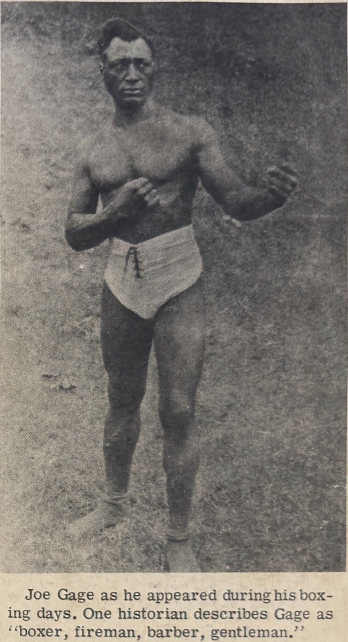
Traveling in Search of Opportunity: In his mid-teens, around the early 1880s, Joe Gage left Pennsylvania to seek better opportunities. He spent time doing odd jobs in Indiana (reportedly in Logansport) and then moved on to Grand Rapids, Michigan by the mid-1880s. This was a time of great migration for African-Americans moving north or west in search of work and safer communities. In Grand Rapids, Gage discovered a passion and talent that would mark the next chapter of his life: boxing. He took up professional prizefighting as a means to earn money. Standing around 154 pounds, Joe fought as a middleweight, and by his own recollection he had 14 bouts during his boxing career, winning 10 and losing 4. Prizefighting was technically illegal in Michigan at that time, so matches had to be arranged discreetly. Gage’s foray into boxing not only provided income but also built his reputation for toughness and tenacity – traits that would serve him well in the years to come.
Life in Ithaca, Michigan (1887–1902)
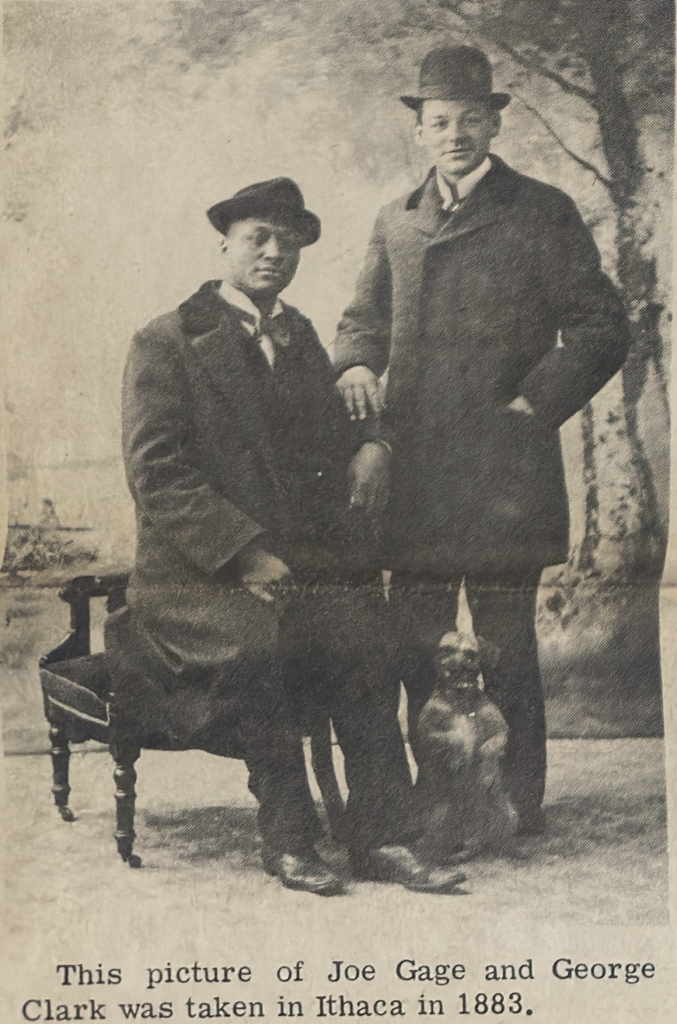
In 1887, 21-year-old Joe Gage arrived in Ithaca, Michigan, a small farming community that had seen very few Black residents before. In fact, local historians note that Gage was Ithaca’s first Black resident, entering an overwhelmingly white town. He quickly found employment at the W. F. Thompson Butter Tub Factory in Ithaca, which made wooden tubs for dairy butter. According to an account in the Alma Record, Joe Gage had come to Ithaca by 1887 and was working as a mill laborer at Thompson’s factory (then located at the corner of Emerson and Main Streets).
Breaking Barriers: Being the first Black man in Ithaca, Gage inevitably encountered some prejudice from townsfolk unaccustomed to a Black neighbor. However, by all accounts he “never backed down and never tolerated it” when facing discrimination. Joe’s confident, courteous demeanor eventually won over the people of Ithaca. He integrated himself by sheer force of character, turning potential hostility into respect. Before long, Gage became an accepted member of the community – and even a local celebrity of sorts.
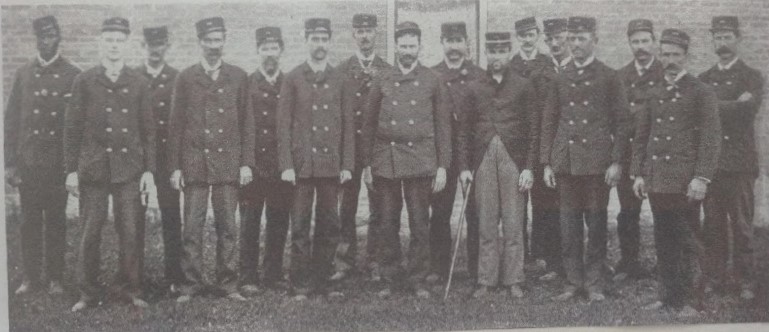
Firefighting and Public Service: One of Joe Gage’s most significant roles in Ithaca was as a volunteer firefighter. He joined the Ithaca Fire Department in the late 1880s, becoming the first (and for many years, only) Black fireman in the town’s history. A surviving 1895 photograph of the Ithaca fire brigade shows Joe Gage standing with his fellow firemen (Gage is identifiable at the far left of the group, hose in hand), a remarkable visual record of his early service. At a time when fire departments were sources of civic pride, Gage’s inclusion in the ranks was groundbreaking. Decades later, a 1954 centennial ceremony in Ithaca would honor Gage and a white colleague, C.D. Peet, as the town’s oldest living fire veterans, each being presented with golden honorary badges for their service long ago. This full-circle moment highlights how Gage’s pioneering contribution in Ithaca was remembered even half a century after he left.
“Colored Champion” Boxer: While living in Ithaca, Joe Gage continued his boxing pursuits and soon gained fame for it. Despite the state ban on prizefights, Gage participated in underground boxing matches across central Michigan. Ithaca residents came to proudly regard him as their “Colored Champion” boxer. His fights drew local interest and added to his mystique. Gage later recalled some of these clandestine bouts: on one occasion a match held at the Ithaca Opera House was broken up by the county sheriff mid-fight, and another time he was chased off the fairgrounds by authorities – only for Gage and his opponent to slip away at daybreak to a forest clearing in nearby Pompeii, Michigan, and finish the fight there. (Gage won that bout by knocking out a man known only as “Ralph from St. Louis.”) Such stories became part of Ithaca lore. Officially, Joe Gage’s boxing record stood at roughly 10 wins out of 14 bouts, but in the court of public opinion he was undefeated in courage. The combination of his firefighting service and boxing exploits made him something of a local hero in Ithaca during the 1890s.
Community and Culture: Beyond work and sports, Joe Gage involved himself in Ithaca’s social life. He was known to have a talent for music and performance. Gage sang at the Ithaca Opera House events and joined a local Mandolin Club that performed popular music of the day. His participation in these cultural activities showed his versatility and helped endear him to Ithaca’s residents. By the turn of the century, Joe Gage had established a solid reputation in Ithaca as a hardworking, upstanding young man. An article many years later noted that Gage had become “somewhat of a legend even in Ithaca” before he left town.
In 1902, after about 15 years in Ithaca, Joe Gage decided to move on. He was then in his mid-30s, still full of ambition and energy. A new opportunity – and another community in need of his talents – was calling him.
A New Start in Flushing, Michigan (1901–1930s)
The next chapter of Joe Gage’s life began in Flushing, Michigan, a village near the city of Flint. In late 1901, Gage’s friend Fred Sayles (a businessman from Flushing) invited Joe to come establish an athletic club in Flushing. Flushing at that time had no gymnasium or organized sports club, and Sayles knew of Gage’s boxing fame. Joe accepted the offer and thus became the first Black man to settle in Flushing (a town that, like Ithaca, had been all-white). He initially intended to stay only a short time – just long enough to get the club running – but things turned out differently. The athletic club venture faltered within months of its launch (the reasons are not well documented). However, Joe Gage had already started to put down roots in Flushing, and he found the town welcoming enough that he decided to stay for good.
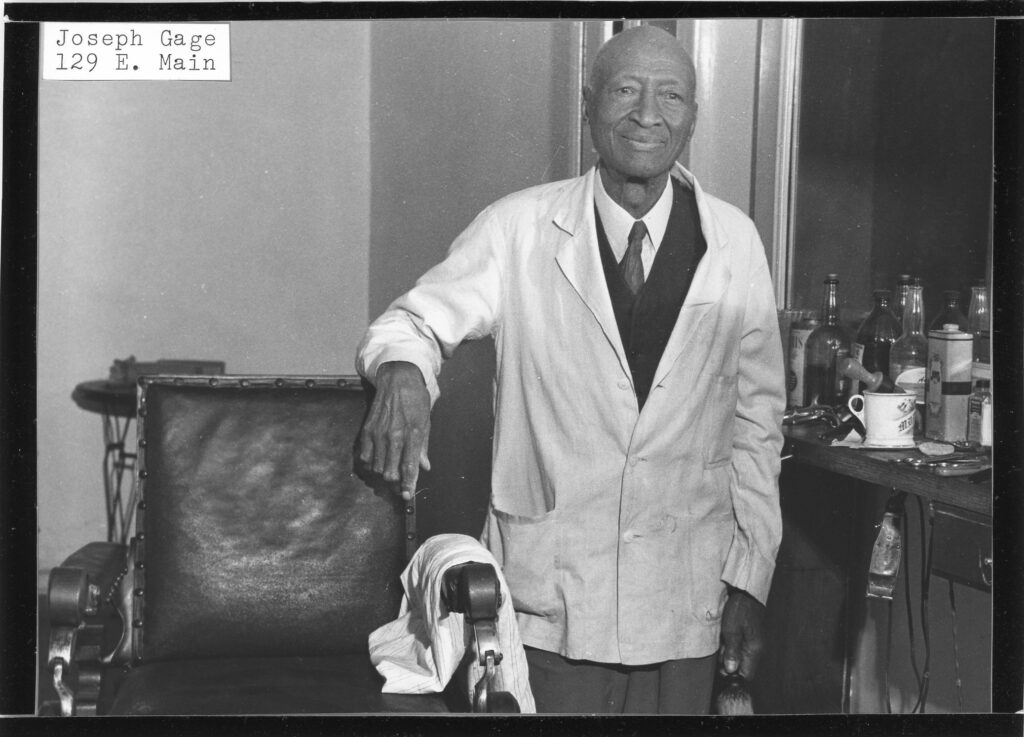
Barbering and Firefighting: After the athletic club closed, Gage leveraged another of his skills: barbering. He opened Joe Gage’s Barbershop on Main Street in Flushing in 1902. Notably, Gage’s barbershop catered to a diverse clientele. It was said that he even specialized in women’s hairstyles, which was unusual for a male barber of that era. Whether trimming a man’s hair or styling a lady’s curls, Joe’s friendly service and skilled hands made his shop a local staple. He would go on to cut hair in Flushing for the next 50 years. (He finally retired from barbering on October 1, 1952, at the ripe age of 86, after “50 years of cutting hair” in the community.) Joe’s shop was more than just a place for a shave or haircut – it became a social hub where townspeople of all ages would gather, gossip, and even be entertained by the proprietor’s antics. Gage was known to spontaneously amuse his customers: “He would stop in the middle of whatever he was doing and put on the boxing gloves to go a quick round with a boy…or play the bones (spoons) and sing” while a patron sat in the chair. His barbershop was truly “the heartbeat of Flushing”, as one resident later recalled.
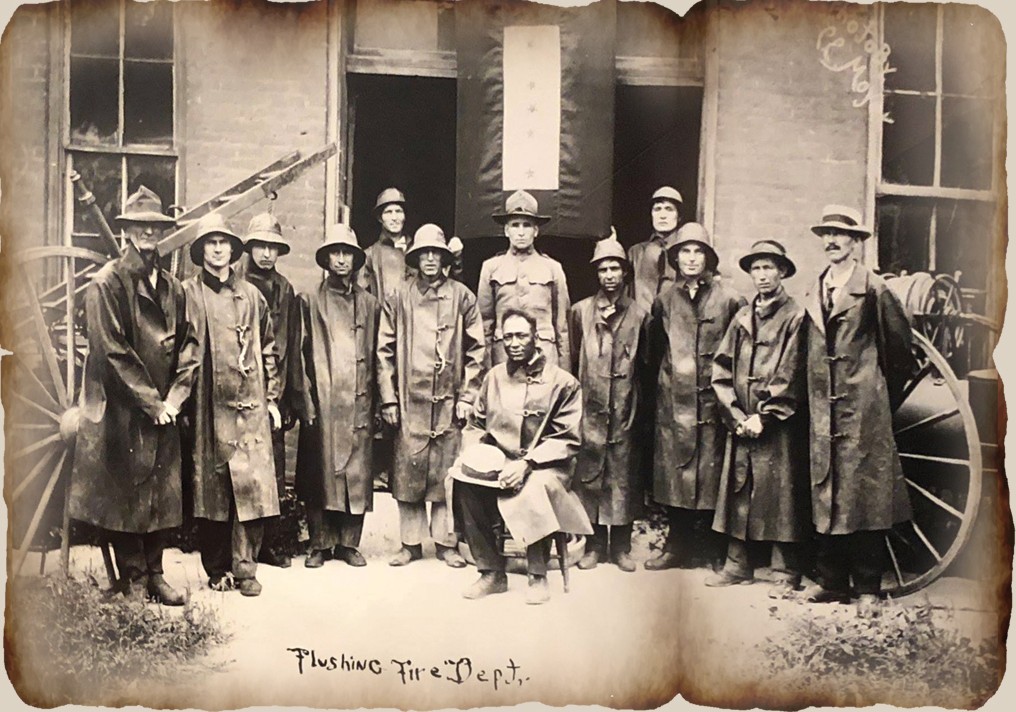
Almost immediately after moving to Flushing, Joe Gage continued his public service by joining the Flushing Fire Department (around 1902). With his prior firefighting experience in Ithaca, Gage became an integral member of the brigade. In fact, over the years he rose through the ranks and eventually became the Fire Chief of Flushing, leading the volunteer fire company. He served as Flushing’s fire chief for about 14 years total (likely in the 1910s–1920s timeframe). A proud photograph preserved by the Flushing Area Historical Society shows Chief Joe Gage standing front-and-center with his firefighting team, highlighting the respect he commanded. Under his leadership, the department modernized its equipment and maintained an excellent safety record for the village.
Marriage and Home Life: On February 6, 1911, Joe Gage married Ida Florence Tennant. Ida was a 29-year-old African-American woman from Pontiac, Michigan, and their wedding took place in Pontiac. After marrying, Joe brought Ida to live with him in Flushing. The couple settled into a house on Chamberlain Street in Flushing. Though Joe and Ida had no children of their own, their home was often bustling with visitors and local youths whom Joe mentored. Joe’s mother, Kate Gage, also lived with them in her later years until she passed away in 1911, and she was buried in Flushing’s cemetery. This multigenerational household reflected Joe Gage’s deep sense of family responsibility. Ida Gage became active in the community as well, supporting Joe’s endeavors and participating in church and charity groups. The Gages’ long marriage (34 years in total) was a partnership that provided Joe stability amid his busy public life. Ida would later fall ill and sadly died in 1945 at age 63, with Joe by her side.
Community Leadership: Joe Gage’s status in Flushing grew steadily. In addition to running his barbershop and leading the fire brigade, he became involved in local governance and civic organizations. Gage was a member of the Flushing Board of Commerce (a group of local business owners); in fact, he eventually served as the Board’s president. He also held a seat on the Flushing Village Council for many years and at one point was chosen as Council President by his fellow councilmen. These prominent roles demonstrate the high esteem in which he was held by the townspeople. It is important to recognize how extraordinary this was in the early 20th century: African-Americans were often excluded from political or economic leadership in most Northern towns, yet Joe Gage was leading white colleagues in both business and government in Flushing. One contemporary described Gage as “one of Flushing’s top men of integrity and high-esteem,” a person whom everyone trusted. By virtue of his character and contributions, he effectively transcended the racial barriers of the time within his community.
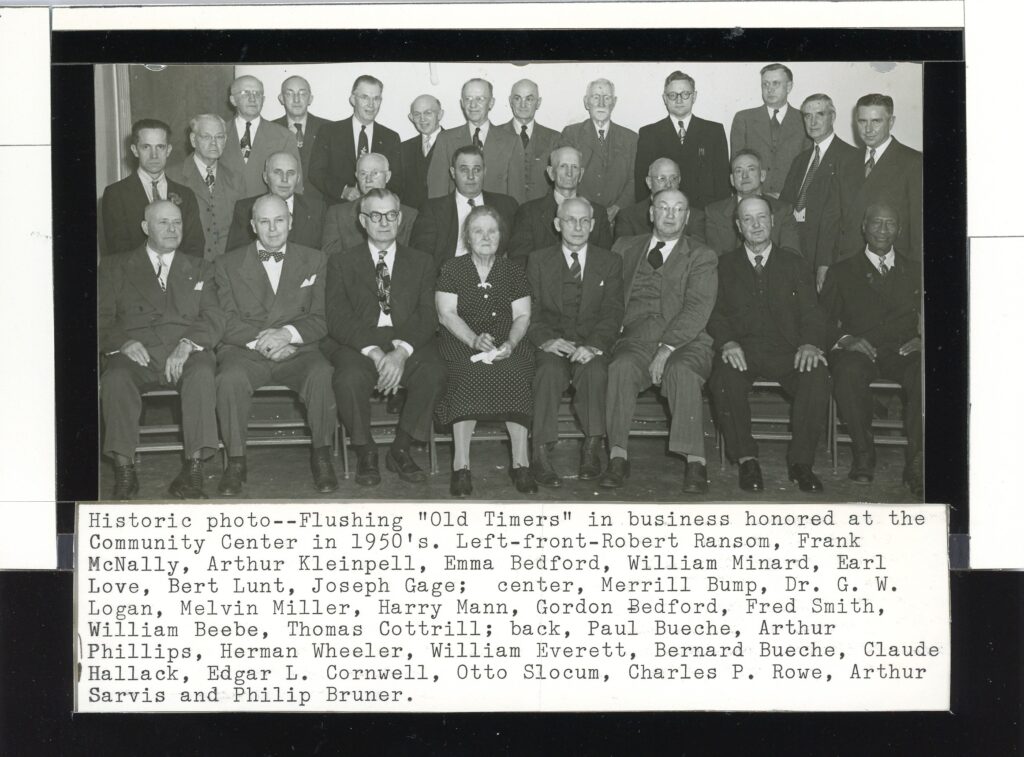
Gage’s influence extended to the town’s youth and social life as well. A lifelong athlete, Joe informally coached boxing and sports to many Flushing boys, often in a back room of his barbershop or at the local gym. He became the village’s first Boy Scout troop leader in 1920, volunteering to organize activities and hikes for Flushing’s Boy Scouts when the nationwide Scouting movement was still new. Gage was also celebrated for his rich singing voice. He joined a popular men’s vocal trio in Flushing (partnering with friends like Ray Budd, who had sung with Joe since the Ithaca days) and performed at countless public events, from church programs to holiday celebrations. Whether it was through music, sports, or civic service, Joe Gage found ways to bring people together. By the 1930s, he was widely regarded as the model citizen of Flushing – someone who always had the town’s well-being at heart.
During the Great Depression and World War II years, Gage, now in his 60s and 70s, continued his work and community involvement. He stepped back from formal leadership roles as younger men took the reins (for example, he eventually retired from the fire department, though remaining an honorary member). However, he never became idle. Well into his 80s, Joe was a daily presence on Flushing’s Main Street, either at his barbershop or strolling to the post office, greeting friends along the way. After Ida’s death in 1945, Joe lived as a widower but was far from alone – the entire community was his family. He even spent a brief period back in Ithaca around 1950 (staying with old friends there), but Flushing was unquestionably home.
Triumphs, Honors, and Later Years (1940s–1956)
By the early 1950s, Joe Gage had become a living legend in Flushing. The accumulated goodwill of five decades was about to culminate in a series of public honors. Although Joe was a humble man who never sought the spotlight, his neighbors felt it was time to celebrate his lifetime of contributions.
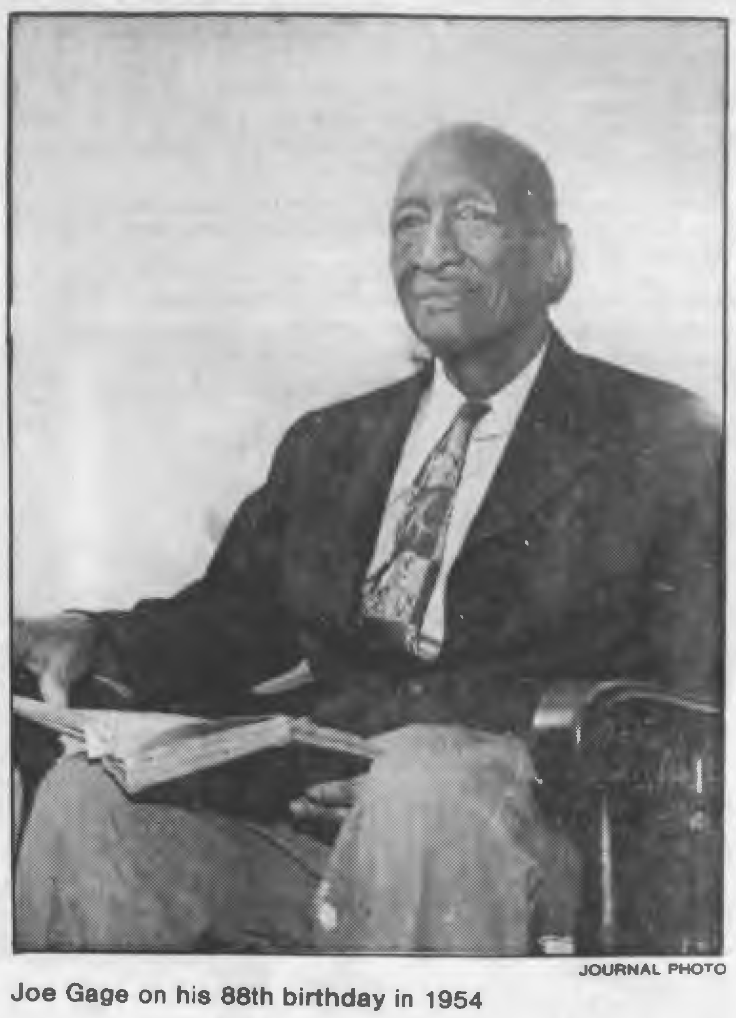
“Joe Gage Night” – 88th Birthday Tribute: In April 1954, as Joe Gage’s 88th birthday approached, community leaders in Flushing organized an event to recognize him. What began as a modest plan by a few citizens soon grew into a major celebration. On the evening of April 9, 1954, hundreds of residents gathered at the Flushing Community Center for a banquet in Joe Gage’s honor. The local Veterans of Foreign Wars chapter and other civic groups helped arrange the dinner, and tickets sold out well in advance (about 200 tickets were snapped up, and even more people showed up after dinner to attend the standing-room-only tribute ceremony). The event was dubbed “Joe Gage Night”, and it stands as one of the largest testimonial dinners in Flushing’s history. Neighbors, former colleagues, and dignitaries all came to pay homage to Joe Gage. In attendance were some who had known Joe since his early days in Flushing, including Fred Sayles (then in his 80s, who traveled from Midland, MI just for the occasion – the same man who had invited Joe to Flushing back in 1901).
During the program, speaker after speaker recounted Joe Gage’s achievements: his leadership of the fire department, his mentorship of youth, his role in local government, and the countless acts of kindness he had shown to neighbors. They presented Joe with an official award naming him Flushing’s “Outstanding Citizen” of the year, and a special birthday cake was decorated to highlight his titles (barber, fire chief, etc.). In a touching gesture, the assembled crowd simply addressed him as friend. One newspaper report noted “there was no higher compliment paid him than the simple word each one used in speaking of him, ‘my friend’.” Indeed, Joe’s ability to befriend anyone and everyone was a theme of the night. Gage, moved by the outpouring, stood up to thank the community. “I don’t think I deserve all this. I’ve lived a long and happy life, especially the part I’ve lived in Flushing,” he said emotionally. It was an evening of mutual admiration: the town grateful for Joe, and Joe grateful for the town.
Return to Ithaca: Later that same year, in July 1954, the city of Ithaca – where Joe had gotten his start so many years before – held a Centennial celebration for its 100th anniversary. Ithaca’s leaders did not forget their first Black fireman. They invited Joe Gage, then 88, to be an honored guest in the Centennial parade. During the festivities, Joe and his old Ithaca firefighting comrade, C. D. Peet (both of whom had served in the 1890s), rode in an open car as the crowd applauded. The two men were then presented with gold ceremonial fire badges to commemorate their service in Ithaca’s early days. This moment was profoundly meaningful: it showed that even a half-century after he left, Ithaca still remembered Joe Gage warmly. It also symbolized how much times had changed – the community that once might have viewed him with skepticism was now proudly claiming him as one of their own, a local hero from the past.
Passing and Obituary: After enjoying these accolades, Joe Gage lived only a couple more years. He remained active and fairly healthy into his late 80s. In early 1956, at age 89, Joe’s health began to decline. He passed away at home on March 6, 1956 (Flushing, MI) after a brief illness. News of his death was met with widespread sadness in Flushing and the surrounding area. The Flint Journal published an obituary titled “From Slave Birth to Civic Leadership – Flushing Barber, Chief Is Dead”, underscoring the remarkable arc of Joe Gage’s life from humble beginnings to respected leader. His funeral on March 9, 1956 was held at the Rossell Funeral Home in Flushing, officiated by Rev. Ellsworth Sutton. Local firefighters served as honor guards, and city officials attended en masse. Joe Gage was laid to rest beside his wife Ida in the Flushing City Cemetery, the same cemetery where his mother Kate had been buried and where, years later, a bronze plaque would be installed to tell his story.
Legacy and Memory: Joe Gage’s legacy has only grown in the decades since his death. He is fondly remembered as the embodiment of small-town American values of the early 20th century – hard work, service, charity, and friendship – and also as a pioneer who quietly challenged racial norms by example rather than by protest. In the 1960s, Flushing author Edmund G. Love wrote a popular memoir of his boyhood called “The Situation in Flushing.” In this book (and in a 1965 Saturday Evening Post article derived from it), Love included a character based on Joe Gage – the character was the village’s only Black resident, a barber, fire chief, singer, and all-around community pillar. Love described how the real Joe Gage would enliven the town with impromptu boxing matches in his shop, or how he’d repair kids’ toys and teach local boys good sportsmanship. The memoir painted Gage as the glue of the community, confirming what Flushings’ residents already knew. Separately, in 1976, as the United States celebrated its Bicentennial, a local Flint-area stage production called “Rogues Along the River” featured a character clearly inspired by Joe Gage, underlining his status as a local legend even in broader Genesee County.
Local historians have ensured that Gage’s contributions are not forgotten. A 1982 retrospective in the Flint Journal aptly called him “a man for all seasons in Flushing” and recounted the extraordinary 88th birthday tribute he received. The Flushing Area Historical Society & Museum today keeps Joe Gage’s memory alive with exhibits – including an “amazing picture” of Flushing’s early 1900s fire team with Chief Joe Gage at the helm and antique firefighting equipment he once used. His name also surfaces in discussions of African-American firsts in Michigan’s small towns, being recognized as a Black trailblazer in public service. Genealogists and family historians have traced his lineage, finding links to the broader Gage family and noting the journey of his parents from slavery to freedom.
In summary, Joe Gage’s life story is a testament to resilience, character, and the impact one individual can have on a community. Born in the shadow of slavery, Gage carved out a place for himself in history not by radical acts, but by daily virtues – he worked hard, helped others, and refused to let prejudice define him. In two Michigan towns, he opened doors that had been closed to people of color, simply by walking through them with dignity. And in both towns, he left behind a legacy of “smiles and respect”. Joe Gage’s journey from coal mines and boxing rings to barbershops and city halls captures a unique slice of American life, inspiring future generations to remember that pioneers and leaders sometimes come from the most unassuming walks of life. His memory continues to be honored as an integral part of Ithaca and Flushing’s local heritage.
Sources: This report is based on a variety of official records, newspaper archives, and reputable historical sources. Key references include: contemporary newspaper articles from the Flint Journal (for example, reports on Joe Gage’s 1954 celebration and 1956 obituary) which document events in his later life; a 1965 historical feature (derived from Edmund Love’s writings) that provides details of Gage’s early life in Pennsylvania and Ithaca; and genealogical records such as census data and Find-a-Grave memorials confirming his birth, death, and family information. First-hand recollections published in local magazines and blogs (e.g., My City Magazine and the Gratiot County Historical Blog) were used to supplement the official record, particularly for anecdotes about Gage’s personality and community reputation. Photographs and museum exhibits (cited above) also corroborate key aspects of his story. All information has been cross-verified and is presented with inline citations to ensure accuracy. Joe Gage’s story, preserved through these sources, remains a proud part of Michigan’s local heritage – illustrating how a man of humble origins became, in the words of those who knew him, “my friend” and an outstanding citizen.