Flushing Founder and Michigan Statesman
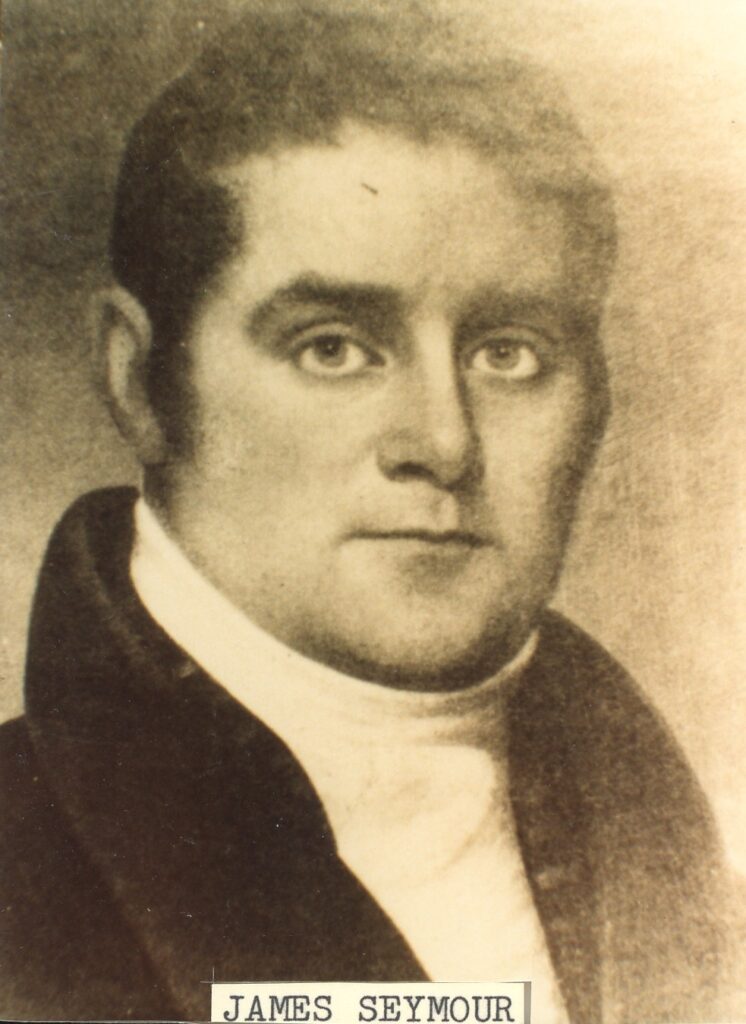
James Seymour (April 1791 – December 30, 1864) was an early Michigan entrepreneur and politician best known as a co-founder of Flushing, Michigan, and a key figure in establishing Lansing as the state’s capital. Born and educated in Connecticut, Seymour built a successful career as a merchant and banker in Rochester, New York before moving west to the Michigan frontier in the 1830s. In Michigan, he and his brother Charles Seymour developed Flushing (Genesee County) by building the town’s first sawmill and officially platting the village. James Seymour later served in the Michigan Legislature and actively lobbied for relocating the capital to his lands on the Grand River, where he financed infrastructure and constructed Lansing’s first hotel. This comprehensive biography details Seymour’s life, emphasizing his role in Flushing’s founding and his contributions to Michigan’s early development
Early Life and New York Business Career
James Seymour was born in Litchfield, Connecticut in April 1791 (historical records list April 20, 1791). He likely spent his youth in Connecticut; in 1818 he married Mira Abigail Hill, starting a family as he established himself professionally. By 1829, Seymour had moved to western New York, joining the thriving business community in Rochester. Over the next 17 years (1829–1846) he worked as a merchant and banker in Rochester, accumulating both experience and capital. This period coincided with a great westward migration and economic expansion in the United States – the opening of the Erie Canal (1825) and the rise of frontier cities like Rochester facilitated commerce and drew ambitious young entrepreneurs to new opportunities. Seymour became a prosperous businessman, giving him the financial resources and connections to invest in land development projects on the frontier.
By the mid-1830s, Michigan was transitioning from territory to state (joining the Union in 1837) and attracting Eastern investors with its abundant land and natural resources. In 1836 – amid this land rush – James Seymour purchased large tracts in Michigan, including a portion of what would become North Lansing in Ingham County, and extensive acreage along the Flint River in Genesee County. Uniquely, the latter purchase was part of a joint venture with his brother Charles Seymour, aimed at founding a new settlement that would later be known as Flushing, Michigan. James remained in Rochester during these initial investments, directing affairs from afar while his brother undertook on-site development. The brothers’ bold push westward set the stage for James Seymour’s most enduring legacies in Michigan’s civic and economic development.Founding of Flushing, Michigan
In the early 1830s, Genesee County’s rich timber lands and water resources drew settlers from New York and New England looking to establish mills and farms. Among the earliest were Charles Seymour (James’s brother) and Horace Jerome, who in 1835–36 acquired a large tract on the Flint River at a site then dense with white pine forest. Their partnership agreement, typical of frontier entrepreneurship, was that Jerome would construct a sawmill and dam, while Charles (backed by James’s capital) would supply logs for milling. By the summer of 1837, a substantial water-powered sawmill was up and running on the river’s east side, marking the birth of what would become Flushing. That sawmill – among the first in Genesee County – quickly became the economic nucleus of the growing settlement, processing timber into lumber for local use and export.
During these early years, the settlement underwent rapid changes. Flushing Township was officially organized in 1838, originally under the name “Dover” until the state legislature approved Charles Seymour’s proposal to rename it Flushing (after Flushing, New York, where Charles had lived). Charles also took steps to formally lay out a village. On **December 3, 1840, he filed the first plat of the Village of Flushing, mapping out lots and streets on both sides of the Flint River. In keeping with common practice, he named the plat after the township. This initial survey, however, proved to have some technical errors (insufficient correction for magnetic north).
The late 1830s were turbulent for frontier businesses due to the Panic of 1837 and the collapse of unstable local banks (often called “wildcat banks”). Flushing was briefly home to one such venture – the Flint Rapids Bank in 1838 – spearheaded by Horace Jerome, but it quickly failed, causing Jerome to leave the area and disrupting the Seymours’ plans. Despite these challenges, Charles persevered with the settlement. He repaired flood damage to the mill dam in 1838 and, with a new partner, built Flushing’s first grist mill in 1840 to serve local farmers.
By 1843, James Seymour decided to take a more direct role in his Michigan investments. That year he purchased his brother’s stake in the Flushing property and enterprises, becoming the primary proprietor of the village lands and mills. (Charles, who had wintered in Michigan since late 1835, made Flushing his permanent home in 1843 and continued to assist before later returning east.) James relocated to Michigan by 1846, moving to Flushing to personally oversee the town’s development. Under James’s leadership, the village entered a new phase of growth. Determined to correct the earlier surveying issues and lay a strong foundation for Flushing’s future, he commissioned a new survey and official plat in 1847 (surveyed by Eber G. Langdon). This second plat – which expanded and corrected the village layout – was recorded by 1855 and solidified the town’s plan of streets and lots. Seymour further expanded Flushing in 1850 by platting an additional section of the village to accommodate growth.
As the principal landowner and founder, James Seymour made lasting civic contributions to Flushing’s early development. He oversaw the mills that formed the economic backbone of the community and helped attract new settlers. He participated in local improvements – for instance, local tradition holds that Flushing was one of the locations initially considered for the new state capital due to Seymour’s influence (though ultimately it wasn’t chosen). He also supported the construction of infrastructure like bridges: a crucial bridge spanning the Flint River at Flushing was built in 1839, linking the settlement’s east and west sides and enhancing transportation and trade. As the village grew, Seymour remained a guiding figure in civic affairs, known for his sound judgment and leadership in the community. Local histories often refer to Charles and James Seymour as the “founders” of Flushing, underscoring their foundational role in the city’s establishment.
Involvement in Lansing and Michigan’s State Capital
In parallel with his endeavors in Flushing, James Seymour was deeply involved in the birth of Lansing, which in 1847 became Michigan’s capital city. As noted, in 1836 Seymour purchased a significant portion of what is now North Lansing (the area along the Grand River in the northern part of present-day Lansing). At that time, this was undeveloped land in Ingham County, but its central location would soon prove strategic. When Michigan’s legislature began deliberating a move of the capital from Detroit to a more central location, Seymour emerged as an influential proponent of the Lansing Township site. He offered part of his land to the state and undertook key improvements to make the site viable: between 1845 and 1847 he financed the construction of the first bridge over the Grand River in that area, a necessary step for any future town to flourish. He also helped establish early civic amenities – for example, the region’s first school and religious services were hosted on or near Seymour’s property in the mid-1840s.
In 1847, the Michigan legislature officially chose Lansing Township as the new state capital. Although Governor William Greenly ultimately selected a specific building site a couple miles south of Seymour’s land, James Seymour’s lobbying and preparation were instrumental in attracting the capital to the Lansing area. Immediately after the decision, he pressed ahead with developing a town on his land just north of the future capitol. In 1847 he laid out the plan for a settlement called “North Lansing”, now known as the Old Town neighborhood. To support the influx of legislators and workers, Seymour constructed the Seymour House – a large hotel at the corner of Franklin and Center Streets – which opened in 1848 as Lansing’s first hotel. The Seymour House quickly became the center of social and political life in the new capital, hosting state officials until more facilities were built. One 1887 account of Lansing’s early years notes that Seymour was “active in securing the location of the capital at Lansing, and in promoting its growth and improvement.” His investments in bridges, buildings, and land development jump-started the rapid growth of Lansing from a collection of forested plots into a functioning city by the 1850s.
Seymour’s dual engagements – founding a town in one part of the state while helping build a capital in another – were unusual but reflected his ambitions and resources. He divided his time between Flushing and Lansing, attending to business and civic projects in both places. This broad commitment to Michigan’s development earned him a reputation as an energetic and visionary pioneer.
Political and Legislative Career
James Seymour’s prominence in his community led naturally to involvement in politics. He was an early member of the Republican Party, which formed in the 1850s. In the 1852 election, voters in Genesee County’s 1st district elected him to the Michigan House of Representatives, where he served a one-year term in 1853–1854. A few years later, he was elected to the Michigan State Senate, representing the 24th Senate district (encompassing Genesee County) for the 1857–1858 term. By the time of his Senate service, Seymour was in his mid-60s – considerably older than many of his peers – and was widely respected for his experience. In the legislature, he was particularly interested in matters of infrastructure and development, consistent with his background in building communities. (For example, during his Senate term Michigan was aggressively pursuing railroad construction and other internal improvements, initiatives that would have benefited emerging towns like Flushing.)
During his tenure as a state legislator, Seymour kept Flushing as his official residence (his home district), traveling to Lansing for legislative sessions. He served on committees such as the State Prison and State Library committees during his Senate term. While specific records of bills he sponsored are sparse in available sources, his lasting achievement in public service was his contribution to shaping Michigan’s civic geography – notably his behind-the-scenes work to facilitate the capital’s relocation. By the end of the 1850s, Seymour had played the roles of town builder, capital city booster, and lawmaker, capping a remarkable career of public service on the frontier.
Death and Legacy
After the Civil War began, Seymour—then in his seventies—retired from active public life. He spent his final years with family in Lansing, where he died on December 30, 1864. Honoring his wish to rest in the community he founded, Seymour was buried in Flushing City Cemetery in Genesee County. His wife, Mira, had predeceased him (she died in 1860) and is also buried in Flushing. James was survived by several children and a large extended family.
James Seymour’s imprint on Michigan is remembered in both Flushing and Lansing. In Flushing, he and his brother Charles are celebrated as the town’s founding pioneers. Local histories invariably begin with the story of the Seymour brothers’ arrival in 1835, the building of the first mills, and the naming of the village “Flushing” at Charles’s suggestion (after their former home in New York, itself named for Vlissingen, Holland). The Seymour name endures in Flushing: for example, Seymour Road commemorates the family’s presence, and historical markers and local lore recount the establishment of the sawmill and grist mill that sparked the town’s growth. The city’s continued existence and growth – it was formally incorporated as a village in 1877, a little over a decade after James’s death – largely validate the foresight of its founders.
In Lansing, James Seymour is remembered for his early and enthusiastic efforts to develop the capital. He is often listed among the city’s founding figures; for instance, a 1887 state history highlights his role in securing Lansing’s selection and building the Seymour House hotel for the first legislators. The Old Town (North Lansing) section of the city, where he concentrated his investments, contains reminders of his contributions – Seymour Avenue and Seymour Park bear the name of his family, and a historical plaque marks the vicinity of the long-gone Seymour House. Through these tangible marks and the historical record, Seymour is remembered as a “man of ability” and a community builder in Michigan’s pioneer era. His story exemplifies the enterprising spirit of 19th-century Americans who transformed frontier territories into thriving towns and cities, leaving a legacy still visible in Michigan today.