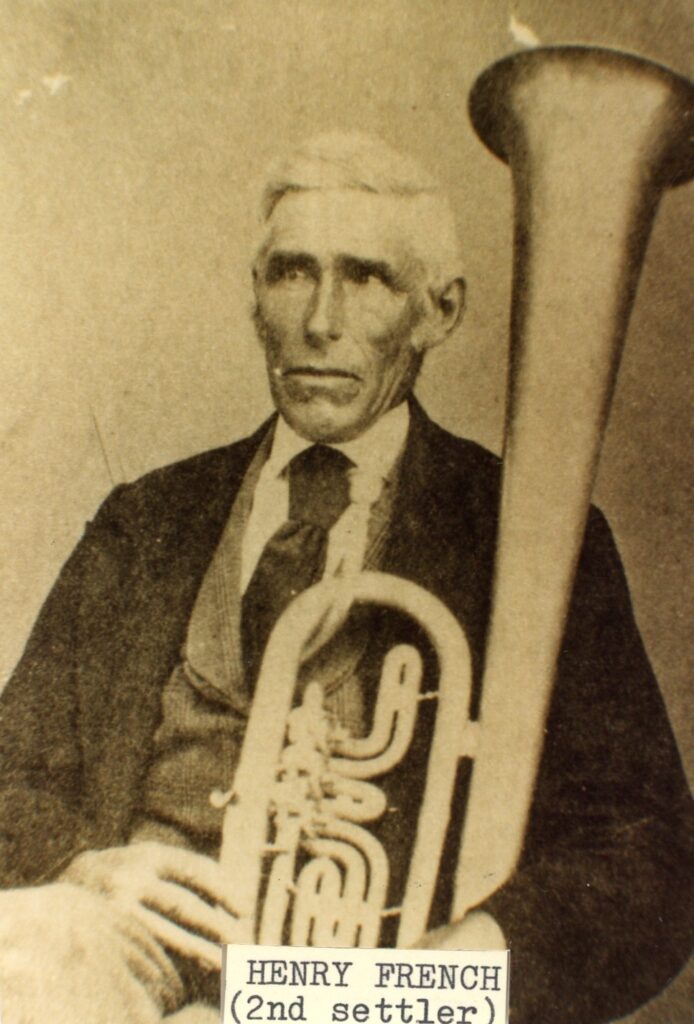
(January 23, 1813 – October 4, 1884) was a Vermont-born pioneer who became a founding father of Flushing, Michigan. He arrived in the Flushing area in the fall of 1835, making him the second permanent settler of Flushing Township (after Rufus Harrison). French staked out a homestead on Section 36 of the township, along the south side of the Flint River, at a time when no other settlers yet resided there. In late 1835, soon after establishing his claim, Henry French traveled to Flint and married Abigail Maria Ensign, a fellow New Englander from Vermont who was then living in Grand Blanc. This marriage was notable as the first recorded marriage of any Flushing settler. The young couple built a log cabin on French’s land and began raising a family on the frontier. In 1837, during a brutal winter that tested all early settlers, Abigail gave birth to a son, George French, who is recorded as the first child born in Flushing Township. This milestone underscored Henry French’s role as a patriarch of the nascent community.
From the very beginning, Henry H. French played a leading role in Flushing’s development. In 1836, he worked for Thomas L. L. Brent, a prominent landowner who had purchased vast tracts in the area. French helped Brent construct a dam and the township’s first sawmill on the Flint River. Like many pioneers, Henry supplemented farming with labor for Brent’s extensive farm operations; through this work, he earned cash or barter goods that were scarce on the frontier. These efforts not only improved French’s own homestead but also contributed to early local industry and infrastructure. In 1838, French joined fellow settlers in meetings to organize local government when Genesee County split the northern townships. Flushing Township was officially created that year (named after Flushing, New York, from which some settlers hailed), and Henry French was among the handful of pioneers eligible to participate in civic affairs. While records are sparse, the community’s “oldest male settler” almost certainly took part in foundational decisions; for instance, early township meetings were held at a neighbor’s home (Ezekiel Ewing’s) to elect officers and arrange a postal route. Indeed, French’s mere presence and continuity in the township – from its founding through nearly five decades – made him an influential figure whose experience was relied upon by later arrivals.
Throughout the 1840s–1850s, Henry French established himself as a successful farmer and landowner in Flushing. He and Abigail nurtured a growing family (in addition to son George, they had other children such as James B. French and Henry “Harry” French, Jr.). French’s farm lay near the Flint River, and he eventually developed a small stone quarry on his property. This stone quarry became historically significant decades later: in the late 1880s, when the Toledo, Saginaw & Mackinaw Railroad was building its line through Flushing, engineers sought local materials for construction. They purchased hundreds of cords of “river stone” from two sources – one being “the quarry of Henry French on the south side of the river” (the other was Sutton & Luce’s quarry on the north side). Thus, stone from the French homestead was used as ballast and fill during railroad construction in 1887–1888, literally forming the bedrock of Flushing’s rail line. Although Henry had passed away by that time, the continued use of his land underscored his lasting contribution to Flushing’s growth: the railroad’s arrival transformed Flushing from a quiet village into a connected town, and French’s former quarry helped make it possible.
Henry French also took part in the civic and social life of the community. As a longtime resident, he was likely involved in early church gatherings and school efforts. (A Baptist society and a Methodist class were active in Flushing by the 1840s, and the first school was started in 1838 in a pioneer lean-to, with families like the Frenches supporting it.) In later years, French was regarded with great respect as an “old pioneer.” Local histories note that by the 1870s he was celebrated as the oldest living male settler of Flushing. When Flushing incorporated as a village in 1877, French, then in his mid-60s, was a living repository of the town’s history – frequently consulted for reminiscences of the settlement days. He lived to see Flushing grow from a handful of cabins to a thriving farm village with churches, schools, mills, and a nascent business district. According to one account, Henry and Abigail French’s home was just south of what became the village of Flushing, and he remained there farming until his final years.
Henry H. French died on October 4, 1884 in Flushing at age 71. He was laid to rest in Flushing City Cemetery, leaving behind his wife (who survived him) and children. At his passing, the community recognized French as a true pioneer of Genesee County – one who had literally carved a homestead out of the wilderness and helped build the institutions of a town. His life spanned the era from Michigan’s territorial days (he arrived just two years after statehood) through the post-Civil War period. In Flushing’s sesquicentennial history, Henry French is fondly remembered as “one of the people who made things happen” in the town’s formative years. His legacy in Flushing includes not only his many descendants (the French family remained active in local affairs for generations) but also the physical imprint of his labor – from the early roads and mills he helped build to the railroad embankments fortified with stone from his land. As a farmer, laborer, family man, and community elder, Henry H. French’s contributions were integral to Flushing’s 19th-century story.
In summary, Henry H. French exemplified the 19th-century American pioneer spirit in Flushing, Michigan. He transformed wild land into a homestead, co-founded a community (providing its first schoolchildren and first native-born citizens), and invested his labor into the area’s earliest economic enterprises. From assisting with the first dam and sawmill to supplying resources for the railroad decades later, French’s fingerprints are on every chapter of early Flushing history. By the time of his death in 1884, what had begun as an “unbroken forest” in 1835 had become a prospering village – due in no small part to Henry French’s lifetime of hard work and civic-minded dedication. His story is integral to Flushing’s heritage, and he is rightly honored in local histories as a key figure “through the years” of the town’s formation.
Sources: Contemporary accounts in the History of Genesee County, Michigan (1879) document Henry French’s arrival, marriage, and pioneer activities. Modern summaries, such as My City Magazine’s history of Flushing, corroborate French’s status as an early settler and note events like the birth of his son George and his work on Brent’s mill. Family records (e.g. Findagrave) confirm his birth in Vermont and death in Flushing. Flushing’s Sesquicentennial compilation further remembers Henry H. French among “the people who made things happen” in the community, cementing his legacy as a foundational figure in Flushing, Michigan history.