Ira Terry Sayre (March 6, 1858 – March 6, 1926) was an American politician, attorney, educator, and community leader in Michigan best known for serving as a state senator and for his pivotal role in the development of Flushing, Michigan. A member of the Republican Party, Sayre represented Genesee County’s 13th District in the Michigan State Senate from 1899 to 1901 (40th Legislature). Before and after his term in the legislature, he dedicated himself to public service in Flushing – holding offices such as township clerk, village president, justice of the peace, and school board treasurer – and made significant contributions to the local economy by founding several community banks. His multifaceted career as a teacher, lawyer, farmer, banker, and public official made him an influential figure in late 19th-century Genesee County, and his legacy includes lasting civic and financial institutions he helped establish.
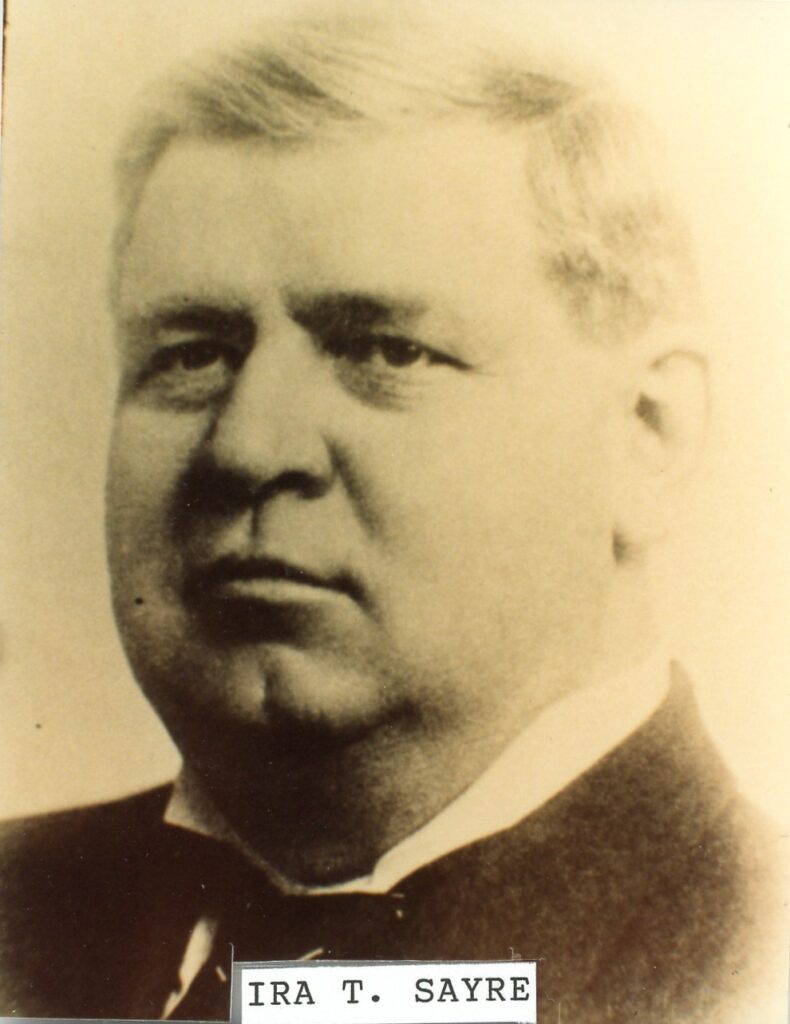
Early Life and Education
Born on March 6, 1858, in Hector, Schuyler County, New York, Ira T. Sayre was the son of Augustus Sayre and Sarah Evelyn (Terry) Sayre. In 1864, when Ira was six years old, his family relocated to Michigan, settling in Flushing Township, Genesee County. He grew up in the Flushing area, where he attended local district schools and completed his secondary education at Flushing High School, graduating in 1878 as a member of the school’s very first graduating class. Sayre pursued higher education, enrolling at Michigan Agricultural College (now Michigan State University) and later attending the University of Michigan Law School during 1880–1881, though he did not complete a degree at either institution. To support his studies, he worked as a schoolteacher during summers in communities such as Flushing, Clayton, and Mt. Morris, Michigan. This early experience in education demonstrated his commitment to self-improvement and public service from a young age.
Legal Career and Public Service in Flushing
Despite leaving law school early, Sayre’s dedication and self-driven study enabled him to enter the legal profession. In June 1881, after passing an examination before the Michigan Supreme Court, he was admitted to the bar on June 12, 1881, and soon established a law practice in Flushing. As a young attorney, Sayre quickly became involved in local governance. He served as Township Clerk of Flushing for seven years and concurrently as Village Clerk for another seven years (roles he likely held during the 1880s). In these capacities, he was responsible for maintaining public records and overseeing municipal administration, contributing to the efficient operation of the local government.
By the late 1880s, Ira T. Sayre had risen to greater prominence in Flushing’s civic affairs. He was elected as a Justice of the Peace, serving in that judicial capacity from 1888 to 1892. In this role, he handled minor legal disputes and local judicial matters, further establishing his reputation as a fair and trusted local official. In 1890, the citizens of Flushing chose Sayre as President of the Village of Flushing (the equivalent of a town mayor). He served a one-year term as village president in 1891. His presidency came at a time when Flushing was growing as a community, and he was involved in overseeing local governance and services. In addition to these roles, Sayre spent six years as treasurer of the local school district, and three years as a member of the Flushing Board of Education, demonstrating his ongoing commitment to education and youth in the community.
Throughout this period, Sayre remained active in his legal practice in Flushing and also engaged in agricultural pursuits and real estate. Coming from a family with farming background, he managed farm property and even invested in real estate (including holdings in Chicago, according to an 1892 biographical record). This diversified professional life – lawyer, part-time educator, farmer, and public servant – gave him a well-rounded perspective on the needs of his community.
Michigan Senate Career (1899–1901)
In 1898, building on his local reputation, Ira T. Sayre ran for the Michigan State Senate. He was elected on November 8, 1898 as a Republican, representing Michigan’s 13th Senate District, which encompassed Genesee County. He took office at age 40 when the 40th Michigan Legislature convened on January 4, 1899. Senator Sayre served a two-year term through January 1, 1901, after which he was succeeded by William S. Pierson. During his Senate tenure, Sayre sat on several legislative committees that reflected the pressing issues of the era. His committee assignments included Education and Public Schools, State Affairs, Railroads, Taxation, Executive Business, and oversight of state Asylums for the Insane at Pontiac and Newberry. Through these roles, he contributed to shaping policies on public education, infrastructure development (railroads), state governance, and fiscal matters in Michigan. Although his service in the Senate was limited to one term, it coincided with a period of significant growth and change in Michigan at the turn of the 20th century. His election itself was noted in local histories as a point of pride for Flushing, underscoring his status as one of the community’s leading figures at the time.
Banking and Business Achievements
After his stint in the state legislature, Sayre channeled his leadership skills into the financial sector, greatly impacting local economic development. He organized the People’s State Bank in Flushing, becoming its first president. This bank was one of the first financial institutions in the village of Flushing and provided critical banking services to the community. Building on this success, Sayre went on to establish additional banks in nearby towns – including Montrose, Goodrich, and Swartz Creek – extending banking and credit facilities to those communities as well. These actions were significant contributions to the economic growth of the region, as small local banks were essential for farmers, merchants, and residents in an era before large national banks reached rural areas.
In parallel with his banking ventures, Sayre continued to practice law in Flushing, serving the legal needs of the community. He also maintained interests in farming and real estate (as noted in earlier biographical accounts). His ability to juggle roles as a lawyer, businessman, and public servant exemplified the versatile leadership common among 19th-century American local leaders.
Personal Life and Community Involvement
On August 5, 1884, Ira T. Sayre married Julia E. Niles, the daughter of Franklin A. Niles. The couple had three children: Helen Lorraine, Sidney Estelle, and Frank (Sidney and Frank were twins). The family made their home in Flushing, Michigan, where Sayre’s father, Augustus, had also settled after retiring from farming in 1890.
Beyond his professional and political endeavors, Sayre was deeply involved in fraternal and community organizations, reflecting his commitment to civic life. He was a Freemason, attaining the 32° in the Scottish Rite, and was a member of the Shriners and a Knight Templar, as well as an Odd Fellow. Additionally, he held a leadership role as the finance auditor for the Great Camp of the Knights of the Maccabees in Michigan, a fraternal benefit society and insurance organization that was influential in the state during that time. These affiliations indicate Sayre’s prominence and respected status in social and civic circles, and his dedication to service extended into charitable and fraternal activities that supported community welfare.
Ira T. Sayre remained an active figure in Flushing for the rest of his life. He passed away on March 6, 1926 – his 68th birthday – in Flushing, Michigan. He was laid to rest in Flushing City Cemetery on March 8, 1926, the same cemetery where other members of his family were interred.
Legacy and Historical Significance
Ira Terry Sayre’s life exemplified public service and community leadership in the post-Civil War and early Progressive Era in Michigan. He helped shape the civic infrastructure of Flushing, serving in nearly every major local office at one time or another, from keeping township records to administering justice at the local level. His election to the State Senate in 1898 brought Genesee County issues to the state capital and reflects how local leaders of small communities could influence state governance. Although he served only one term, his work on committees for education, infrastructure, and state affairs contributed to legislative discussions on improving schools, expanding railroads, and reforming taxes in Michigan.
Perhaps Sayre’s most lasting impact was in the realm of local finance and community development. By founding the People’s State Bank of Flushing and additional banks in surrounding towns, he provided residents and businesses with access to financial services. The People’s Bank building in Flushing even became a civic landmark – it later housed the town’s library on its second floor in 1913, demonstrating how the institutions he established continued to serve the public. His leadership in fraternal organizations like the Masons and the Maccabees further solidified his legacy as a pillar of the community who dedicated time and resources to civic improvement and social welfare.
Nearly a century after his passing, Ira T. Sayre is remembered as a notable figure in Genesee County’s history, often cited in historical accounts of Flushing’s early development and governance. His life story – from a young man in the first graduating class of the local high school, to a teacher, self-made lawyer, public official, bank founder, and state legislator – paints a picture of the opportunities and responsibilities embraced by 19th-century American community leaders.