Rufus Harrison: Flushing’s First Settler
April 12, 1795 – Nov 8, 1856
Long before there was a village called Flushing, before Main Street, the railroad, or the mills, one family stepped into a deep Michigan wilderness along the Flint River and made it home. That family was Rufus and Sarah Harrison, and their story marks the beginning of permanent settlement in what would become Flushing Township.
In June 1835, Rufus and Sarah Harrison arrived from Wayne County, New York, following the same westward path taken by many early Michigan settlers. Rufus was a native of Connecticut, and Sarah was born in Canada. They brought with them two young children, Warren and Harriett, and a willingness to start over in a land that was, at that time, dense forest and river bottom.
They chose a site on the north bank of the Flint River, just west of where Flushing Road and Elms Road meet today. There they built a small log cabin, the first permanent settler’s home in the Flushing area. Later accounts simply and memorably describe the scene at their arrival:
“No one was here—just the Indians.”
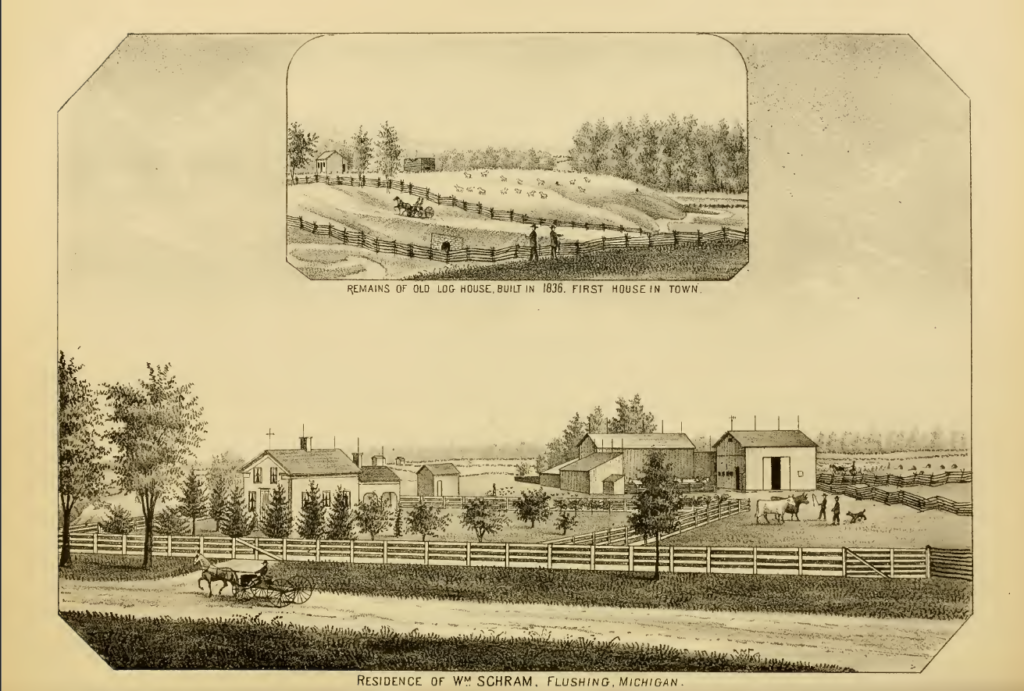
That log cabin, and the farm that followed, stood within sight of what later became the Harrison and Schram farms at Flushing & Elms—ground that would remain closely tied to the family for generations.
A life carved from the wilderness
Life along the river demanded ingenuity. One of the best‑loved stories about Rufus Harrison involves his homemade corn‑grinding “mill.”
To grind corn for his family, Rufus cut down a black oak tree and burned out the center of the stump to form a deep wooden mortar. About ten feet away, he set up a crotched pole, like the sweep of an old‑fashioned well. Where a water bucket would normally hang, he fixed a heavy wooden block. By swinging and dropping that block into the hollowed stump, he could pound and mash the corn into meal.
It was simple frontier technology, but it tells us a great deal about the resourcefulness required to live here in the 1830s.
From river cabin to Flint businessman
Although the Harrisons are remembered as Flushing’s first settlers, they did not remain on the original river homestead for long. As the region developed, the couple moved to Flint, where Rufus became a well‑known businessman and civic figure.
His contribution to that growing town lives on in its map: Harrison Street in Flint bears his name, a lasting reminder of his role in the area’s early development.
He also held township offices during his time in the Flushing area, helping to shape local government as Genesee County’s townships and communities took form.
Family ties: the Harrison–Schram connection
Rufus and Sarah had two children:
Warren Harrison
Harriett Harrison, who would become an important link between the Harrison pioneer story and one of Flushing’s best‑known farm families.
On December 15, 1852, Harriett married William Schram in Flint. Schram had come to the area in 1836 from New York State. After their marriage, Harriett and William purchased a 170‑acre farm on Flushing Road, directly across (to the north) from the original Rufus Harrison farm.
There they built a frame house and large barns—a home that still stands at the northwest corner of Flushing and Elms Roads, long known locally as the Schram home.
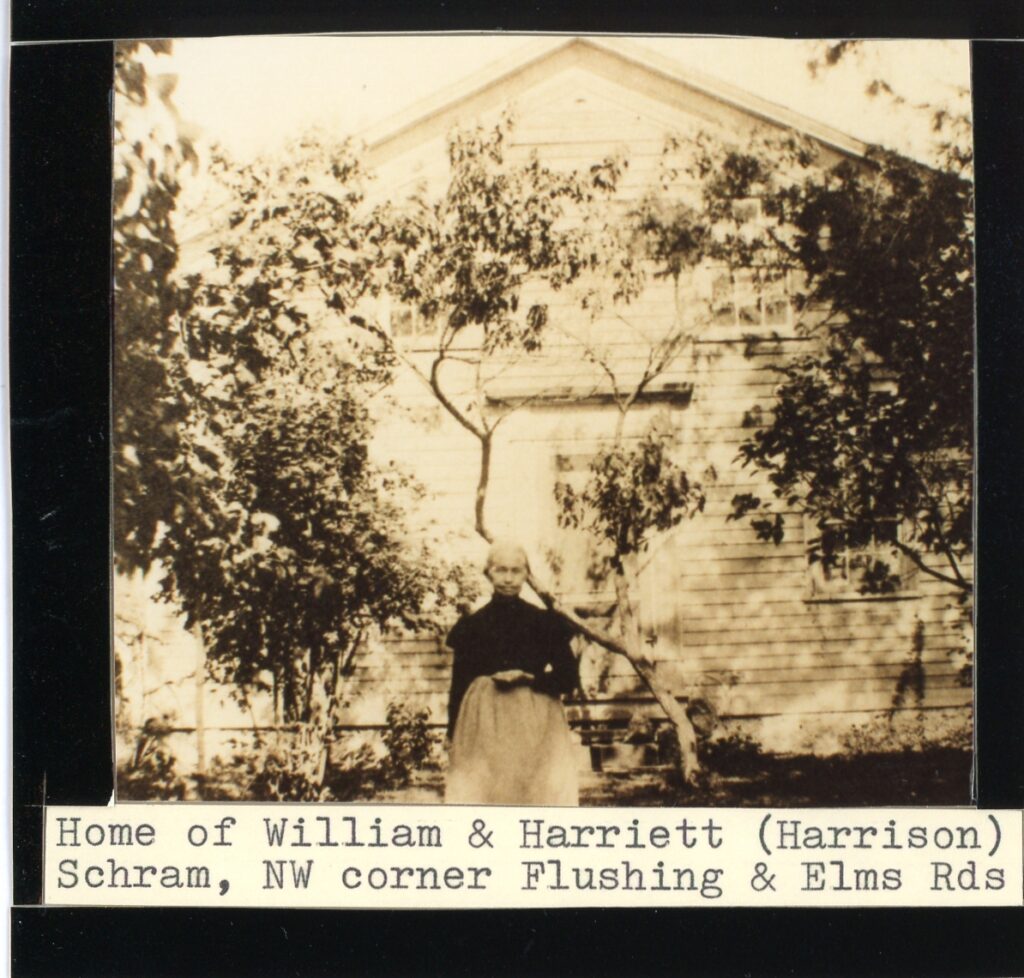
In her later years, Sarah Harrison lived with her daughter and son‑in‑law on the Schram farm and died at the remarkable age of 92.
A year of loss: 1856
The year 1856 brought a double tragedy to the Harrison family. In early November, Rufus Harrison died on November 4, and only four days later his son Warren died on November 8. Contemporary accounts simply note that father and son died “a few days apart,” making it a particularly heavy blow to one of the area’s founding families.
Both men were laid to rest in Flushing Cemetery, in what became known as the Schram family lot—a fitting symbol of the close ties between the two families.
In that same lot lie:
Sarah Harrison
Harriett (Harrison) Schram
William Schram
Today, visitors to Flushing Cemetery can still find the grave of Rufus Harrison, often described in our tours as “the grave of Flushing’s first settler.”
Why Rufus Harrison still matters
For the Flushing community, Rufus Harrison’s significance goes far beyond a single headstone or a log cabin long since vanished.
His story helps us understand:
How settlement began: One family’s decision in 1835 to make a home along the Flint River opened the way for others who followed.
How the land was first used: The farms at Flushing & Elms mark some of the earliest cleared and cultivated ground in the township.
How families shaped the town: Through Harriett’s marriage to William Schram, the pioneer Harrison story flows directly into generations of Schram family history in Flushing.
How memory lives in place: From Harrison Street in Flint to the Schram farm home and the Schram lot in Flushing Cemetery, the Harrison name remains woven into the geography of our everyday lives.
When we stand at the corner of Flushing and Elms Roads, look across the fields, or walk the quiet rows of Flushing Cemetery, we are still moving through the landscape that Rufus and Sarah Harrison first chose nearly two centuries ago. Their story is the first chapter of Flushing’s story—and it continues to shape how we remember and celebrate our community today.