A Man Laid Down His Life for His Friends
Bomber Crash Flushing, Michigan December 22, 1951
By: David Trojan
June 25, 2025
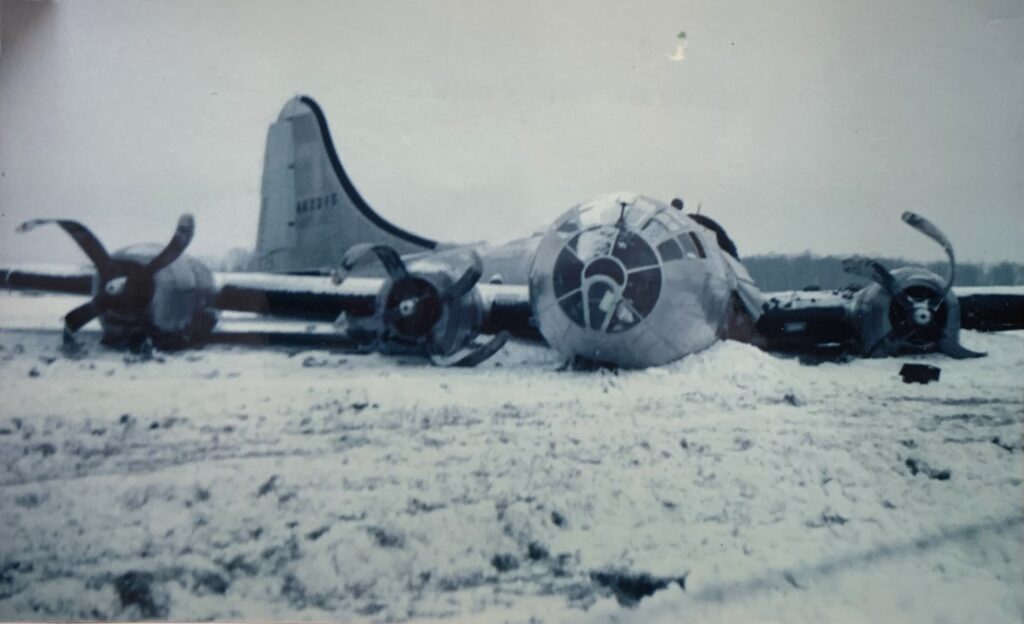
Photo of a crashed B-29 Superfortress bomber in a field near Flushing, Michigan
This investigation was prompted by several members of the Experimental Aircraft Association Chapter 77 in Flushing, Michigan, who asked me to investigate the story of a nearby bomber crash. I obtained newspaper articles that provided the basic information, and the Official Accident Report that provided all the details. This story revealed some interesting facts about the history of the aircraft involved, the events that led to the accident, and the controversy surrounding the cause of the crash. This investigation also revealed a tragic story and led me to discover a forgotten hero.
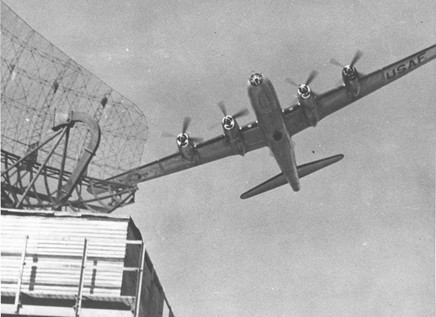
B-29 assigned to the 109th Radar Calibration Squadron, Griffiss AFB, New York
The bomber that crashed was TB-29 Superfortress, serial number 44-62215. It was assigned to the 109th Radar Calibration Squadron at Griffiss Air Force Base in New York. The base housed radar calibration units that used B-29s for testing and training. Griffiss AFB played a significant role in the B-29 program by developing bomber intercept tactics for fighters during the early 1950s. Superfortresses were also used there to fly in front of military radar installations to determine how accurately they could be tracked on radar and the effectiveness of the ground equipment. Some of the B-29s assigned to Griffiss AFB were equipped with radar jamming devices to train personnel in electronic warfare techniques. Squadron members at Griffiss AFB nicknamed their B-29s after the characters in Snow White and the Seven Dwarfs, and they were known as the “Snow White Squadron”. The most famous of the aircraft assigned to the 109th Radar Calibration Squadron at Griffiss AFB is “Doc”, which is one of only two still flying B-29s in the world. It was also converted to a radar calibration aircraft in 1951 and stationed at Griffiss AFB, N.Y., at the same time as 44-62215. Research revealed that only “Doc” 44-69972 and “Dopey” 44-70016 are known. The other named dwarfs associated with serial numbers are unknown. There is a very good chance that 44-62215 was named after one of the dwarfs, but it is unknown which one.
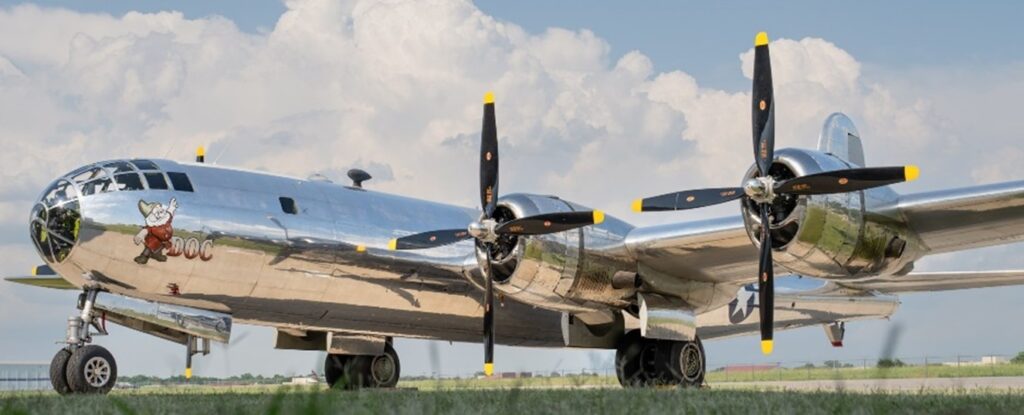
B-29 serial number 44-69972 “Doc”
B-29 “Doc”
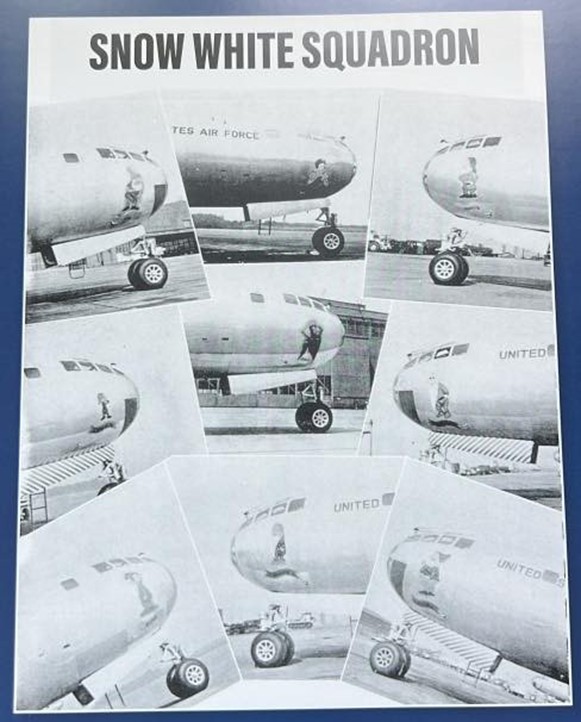
The B-29s of the Snow-White Squadron at Griffiss AFB
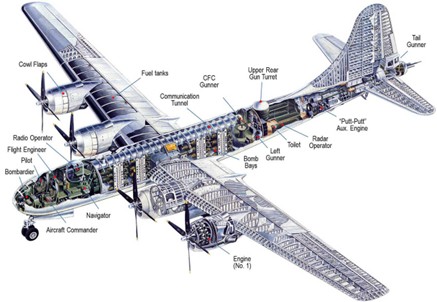
The B-29 Superfortress was a heavy bomber used by the United States during World War II and the Korean War. It’s particularly known for delivering the atomic bombs on Hiroshima and Nagasaki in 1945. The B-29 was a technological marvel of its time, featuring innovations such as pressurized cabins and remotely controlled gun turrets. 3,970 B-29s were built between 1943 and 1946.
B-29 General Characteristics and Performance:
Length: 99 ft 0 in Wingspan: 141 ft 3 in Height: 27 ft 9 in
Empty weight: 74,500 lb Gross weight: 120,000 lb
Max takeoff weight: 133,500 lb
Powerplant: 4 × Wright R-3350 18-cylinder, 2,200 hp each
Propellers: 4-bladed constant-speed fully feathering propellers, 16 ft 7 in diameter
Maximum speed: 357 mph
Cruise speed: 220 mph
Stall speed: 105 mph
Range: 3,250 mi
Ferry range: 5,600 mi
Service ceiling: 31,850 ft
Rate of climb: 900 ft/min
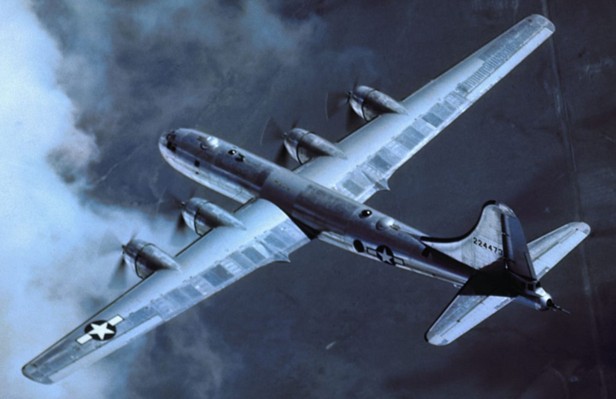
B-29 Superfortress in flight
The Official Accident Report was 188 pages long and included one map and several photos. The report detailed what happened during the flight.
The 8-man crew aboard the B-29 Superfortress aircraft was:
Pilot 1st Lt. Robert D. Phelps, Veteran of World War II, former B-17 pilot
Copilot 1st Lt. Andrew J. Redlin
Navigator 1st Lt. Donald McConachie
Navigator 1st Lt. Edward M. Burtsavage
Navigator 2nd Lt. Dave E. Piogoni
Flight Engineer T/Sgt Roland D. Shields
Crewmen Right Scanner T/Sgt Elliott Miller
Crewmen Left Scanner S/Sgt Donald Flansburgh
TB 29 serial number 446-2215 departed Griffith Air Force Base, New York, for a flight to Minneapolis, Minnesota, on 10 December 1951 at 3:45 pm EST. After an uneventful five-hour training mission, the B-29 landed at Minneapolis and was serviced with 2190 gallons of fuel. It was then discovered that the number one and number three main fuel cells were leaking. The leak was found to be coming from the interconnect located in the port wheel well on the outboard side. When they defueled the aircraft for maintenance, they discovered hunks of ice measuring 2-4 inches at the bottom of the tank. The repair required several days to complete.
On Friday morning, 21 December 1951, the aircraft was refueled and checked for possible leaks; none were found. The fuel tanks were also checked for water during the preflight, and none was found. An attempt was made to return to New York that evening but was postponed due to the inability to get the number three engine started due to the cold climate conditions and to replace the auxiliary power unit generator. The pilot also decided to let the aircraft sit overnight and check for fuel leaks in the morning. The following day, 22 December, heating units were applied to all four engines, and they started normally. The pre-takeoff checklist was gone through, with everything checking out satisfactory. The aircraft departed Minneapolis, Minnesota, at 2:47 pm CST for the cross-country navigational flight back to Griffiss AFB, N.Y. The weather was clear with VFR flying conditions.
The takeoff was made with the Flight Engineer switches in the following positions: four main fuel shut-off valves open, main tank fuel boost at low speed, manifold shut-off valves closed, center wing tank closed, and center wing tank boost pump off. The climb to 13,000 feet was made with this fuel arrangement, and upon reaching that altitude, the aircraft’s power was pulled back to 32 inches and 2200 RPM with the turbos set to 8. The center fuel tank was put in an open position, and this fuel arrangement was used for approximately one hour. After an hour, the center wing fuel tank was returned to the closed position. This arrangement had each engine running directly from its own main fuel tank.
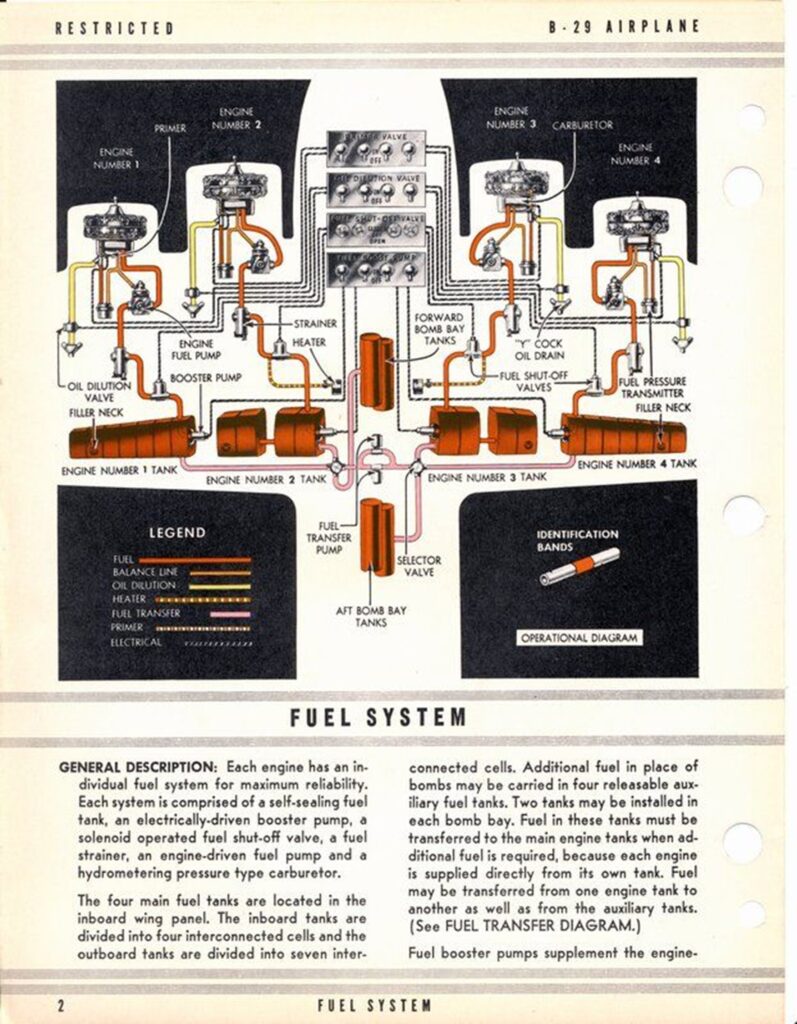
B-29 Fuel System, note that each engine is supplied directly from its own tank
As the flight progressed, position and status reports were given along the route to stations with no indication of any trouble as the aircraft cruised at 13,000 feet. About 1 hour 15 minutes after takeoff, and about 15 to 20 minutes after switching from the center tank to the main wing fuel tanks, difficulty was experienced with the engines.
The number two engine started to run rough and cut out. A short time later, engines one and three also started intermittently cutting in and out, which resulted in a loss of power and a loss of altitude. At 5:12 pm, aircraft 44-2215 made an emergency radio call to any station in the area, reporting that it was in difficulty, descending, and unable to maintain altitude.
When the engines started to cut in and out, the Flight Engineer noted on his instrument panel that fuel flow gauges were oscillating and the fuel pressure gauges were dropping to zero and fluctuating. The Flight Engineer thought he had ice in his system and asked the pilot for a lower altitude. The Flight Engineer placed the main tank booster pumps in the low-speed position, with no results obtained from this procedure. He then placed the booster pumps in the high-speed position with no apparent results. While the aircraft was still descending, the Flight Engineer attempted to start the engines by various arrangements of the center wing and main engine tanks without success.
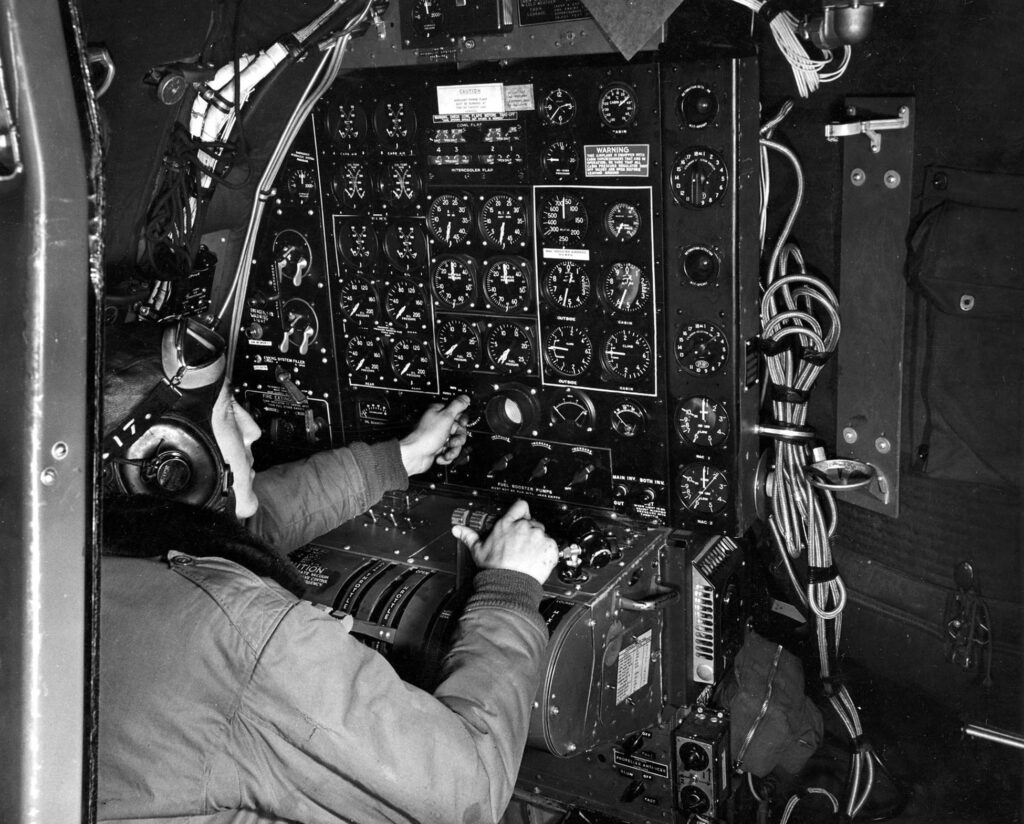
B-29 Flight Engineer position
The pilot had hopes of making an emergency landing as he had received headings to several airfields and had been given landing instructions and runway conditions. It soon became apparent that an emergency landing could not be accomplished. The aircraft continued to descend, and at 7000 feet altitude, the order was given by the pilot, Lt. Phelps, “Prepare to Bail Out!”. All four engines were cutting in and out and surging at different intervals, which caused the shifting of the balance of power by the engines and made the aircraft hard to control during the descent. The engineer was ordered to lower the nose gear and open the nose wheel escape hatch. At approximately 3500 feet and 2700 feet above the terrain, the “Bail-out!” order was given. The aircraft engines were continuing to cut in and out, and the aircraft was descending 1600 feet per minute, going approximately 250 mph. The Flight Engineer, T/Sgt Shields, was still attempting to bring the engines back on by manipulation of the central engineers’ panel until he was told by the pilot to bail out at approximately 750 feet above the ground. The Flight Engineer, on leaving his seat, made one last swipe of his hands at the fuel switches to turn them off on the engineer’s panel before bailing out through the nose wheel escape door. The crew narrowly escaped the aircraft by exiting within 90 seconds after the order was given. Seven men parachuted to safety from the crippled B-29.
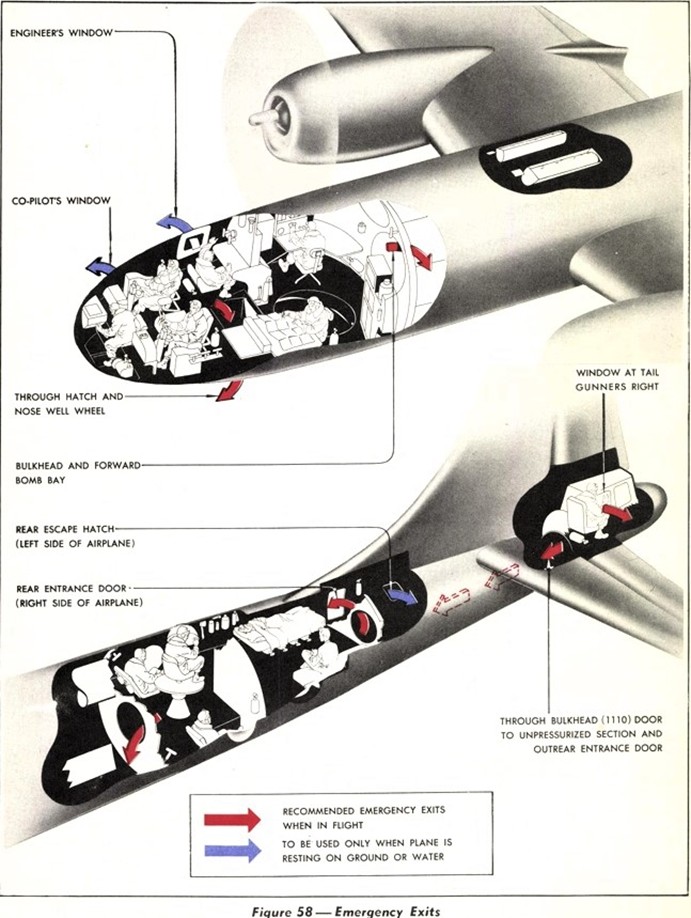
B-29 Emergency Exits. The crew in the forward section of the aircraft bailed out through the nose wheel well. The crew in the aft section of the aircraft bailed out through the rear entrance door
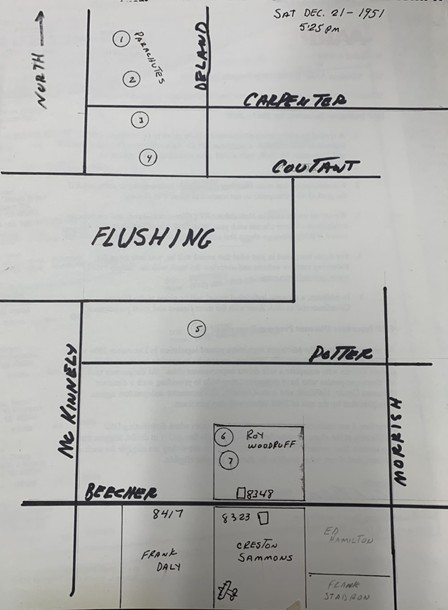
Location of property owners in 1951, and where the crew landed after they bailed out of the B-29 bomber, drawn by a local farmer
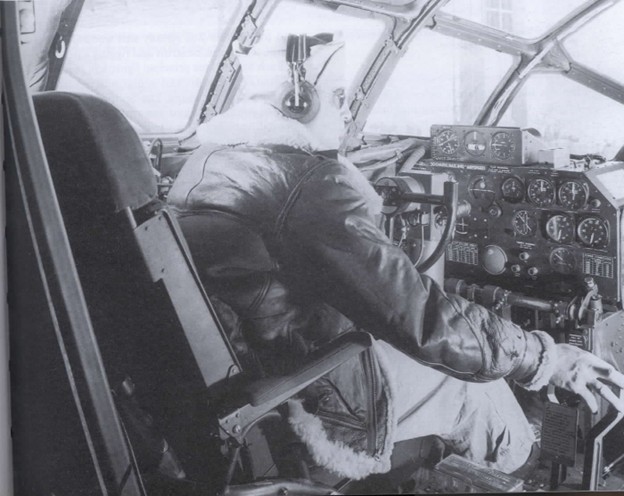
Pilot of a B-29 at the controls
The pilot, 1st Lt. Robert Phelps, stayed at the controls of the faltering Superfortress to give his crew time to jump. He then flew the plane towards a snow-covered field near Flushing, Michigan, to avoid crashing into the nearby industrial city of Flint, Michigan. He was the last to bail out of the aircraft at less than 500 feet above the terrain just before it crashed. His parachute was only partly open when his body crumpled into the snow-covered alfalfa field. The body of Lt. Phelps was found approximately 150 feet ahead of where the aircraft first struck the ground, indicating that Phelps had cleared the aircraft a split second before the time of initial impact. The crew gave credit to the dead pilot for “The best Christmas present our families could ask.”
The aircraft crashed at 5:25 pm EST, only about 15 minutes after the first engine trouble started and ½ mile from the point where the last man parachuted. The B-29 Superfortress Bomber crashed 5 ½ miles northwest of the Flint Airport and two miles south of Flushing, Michigan. The B-29 bomber crashed across snow-covered farm fields, including the Creston E Sammons Farm, located at 8323 Beecher Rd. The crash site was constrained by Beecher Rd, McKinley Rd, Marrish Rd, and Cackins Rd.
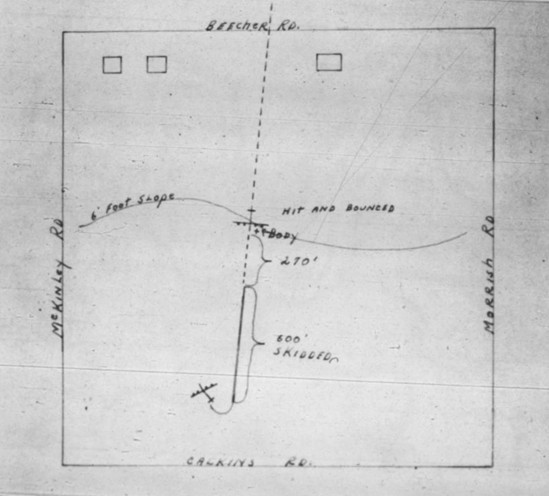
Map from the Official Accident Report
The aircraft impacted a small rise in the terrain with the imprint of the four engines in the snow-covered ground and immediately bounced. The aircraft hit again 270 feet ahead and was slightly heavy on the right side. It then slid 600 feet, made a turn to the right of 135°, and finally stopped after plowing through snow 14 inches deep. The tail section broke off aft of the center wing tank and was bent to the right 20°; however, it was intact with no buckling of the skin. The forward section, including the engineers’ compartment, also broke to the right just ahead of the wing, but was in excellent shape, indicating that the ship had flared out before hitting the ground. No windows were broken in the forward section, and the windows were still fully operational. The forward section had little damage and was reported in “excellent shape.” There was no fire. The official accident report noted that the propellers were bent forward, indicating 2,3,4, engines were running and producing power at the time of impact.
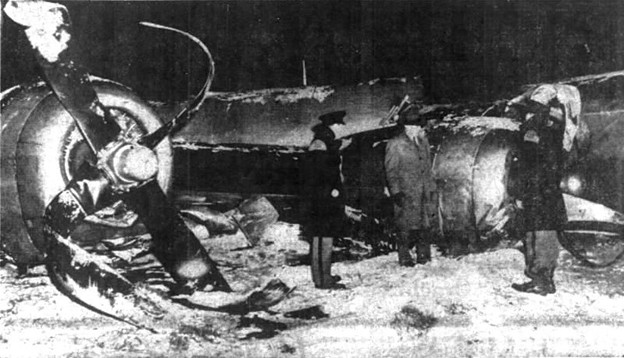
State police inspect the B-29 bomber just after it crashed, newspaper phot
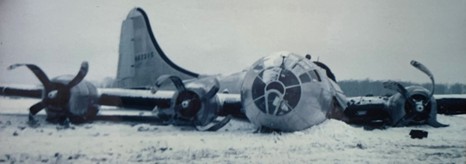
Photo of a crashed B-29 Superfortress bomber in a field near Flushing, Michigan, photo taken by one of the local farmers soon after the accident.
The Official Accident Report contained several photographs of the crash site.
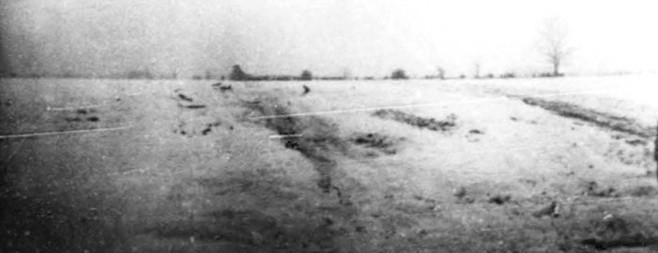
The point where the aircraft hit and then bounced 270 feet, then skidded across the field 600 feet
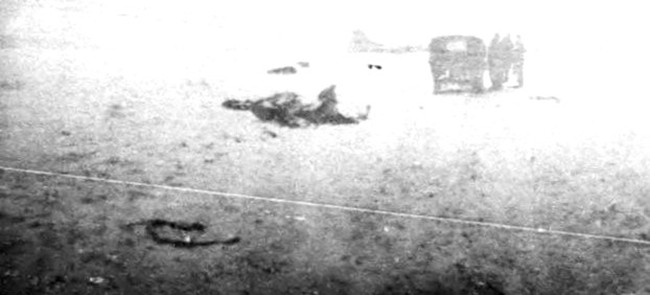
Wreckage along the path of the B-29 bomber as it skidded across the snow-covered alfalfa field
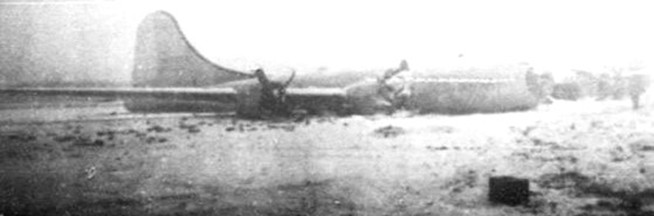
The forward section had little damage and was reported in “excellent shape.” There was no fire
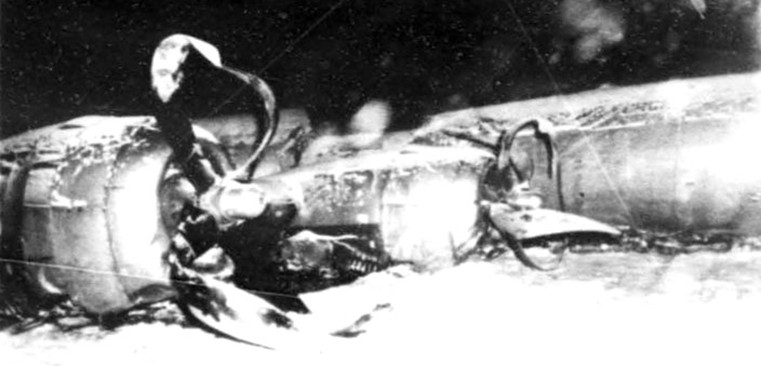
The official accident report noted that the propellers were bent forward, indicating 2,3,4, engines were running and producing power at the time of impact
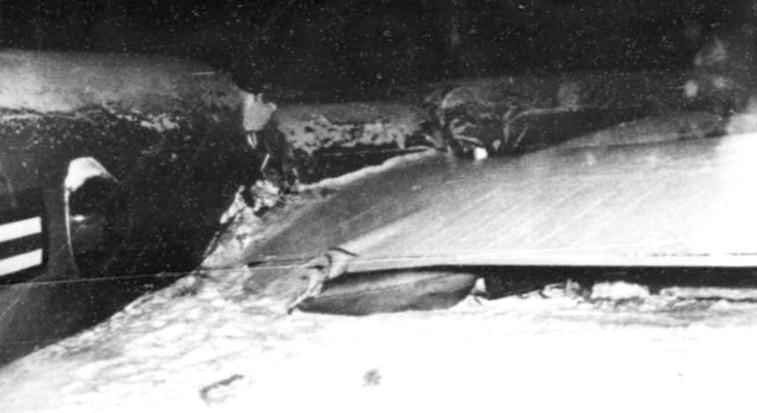
The aircraft broke into 3 sections, the forward section just ahead of the wing, the tail section broke aft of the center wing tank
The aircraft accident investigation team arrived the next day, 23 December, from the Seventh Radar Calibration Squadron at Griffiss AFB. The center wing fuel tank was found to be empty with no evidence of spillage or seepage, or leakage on the ground. Bombay fuel tanks were not installed in this aircraft. The fuel levels for the four main wing tanks were checked and found to be approximately 4500 gallons. Fuel samples were taken for analysis and came back with negative results for contamination. Investigators completed an inspection of the entire fuel system on the aircraft. All switches were found to be in the normal position except the main fuel tank shut-off valves.
Salvage of the aircraft began soon after the crash. Aircraft components, especially the fuel system, were removed and tested. Nothing was discovered that would indicate there was a mechanical defect in the aircraft, engines, or fuel system that would cause the accident. Investigators believed that the accident resulted from fuel mismanagement by the Flight Engineer. The main tank and center wing tank switches were found in the off position, which investigators believed caused fuel starvation to the engines.
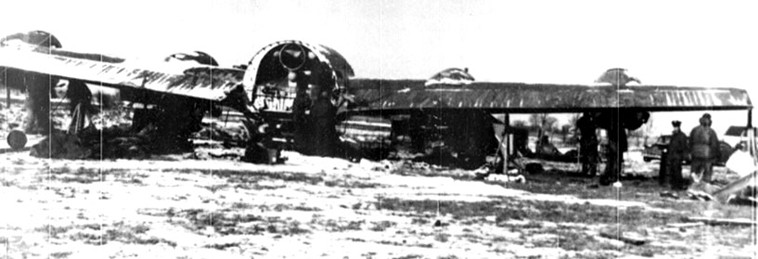
B-29 wreck during salvage operations. Engines, forward and aft sections removed
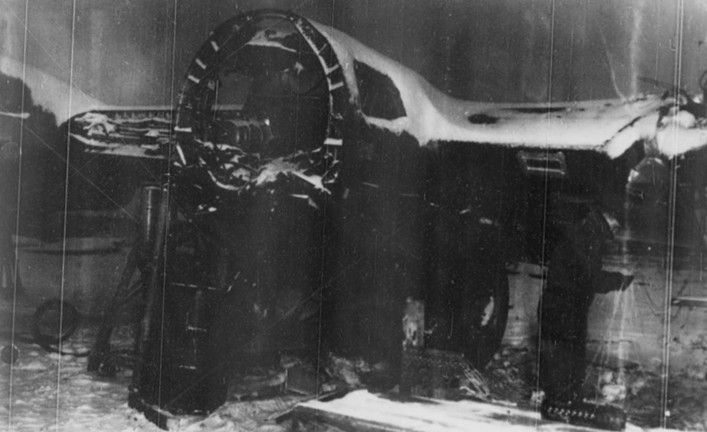
Salvage work on the crashed B-29 bomber
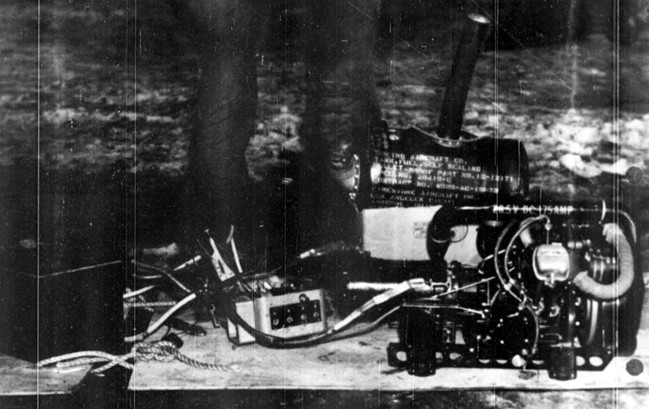
B-29 fuel system after removal from the crashed aircraft, undergoing testing
The Official Accident Report listed three possible causes of the accident. In the opinion of the accident board, the accident resulted in one of the following three conditions. However, it was not possible to determine which of the conditions was the one that caused the accident.
- The flight engineer at some point during the flight inadvertently turned off the main tank shut-off valve without realizing it, apparently failing to notice this mistake. During his ensuing difficulty, he then turned them on one at a time and off again without giving the engines time to catch, but giving the lines enough gas to allow the engines to run for only a couple of seconds.
- Failure to turn off the center wing tank and the manifold shut-off valves, thereby allowing air to enter the system after the center wing tank had been drained of fuel by negative pressure in the manifold lines, caused by engine-driven pumps.
- Ice crystals accumulated somewhere in the lines between the tanks and the engine-driven fuel pump. This situation would have had to have occurred in four different systems within a period of five minutes. The board feels that either ice or water would still have been present somewhere in the lines between the tanks and the engine-driven fuel pumps.
The board believed that the cause is either 1 or 2 listed above. However, numbers 1 and 2 could have been combated by the proper corrective action on the part of the Flight Engineer.
The board recommended that the main tank switch be protected by a spring-loaded switch guard, keeping it in the open position.
The Flight Engineer submitted an unusual Letter of Rebuttal to the findings of the Official Accident Report, and this letter was included in the official record. He desired to say that he did not feel his actions in any way contributed to the cause of the accident. He tried every method and corrective action that he knew of to correct the situation. He felt that he had done everything that he could, and that his actions were in no way a contributing factor to the accident. He claimed he tried several combinations of switch setups, but none worked. He believed that the accident was caused by ice in the fuel lines, which caused fuel starvation.
Included at the end of the Official Accident Report was a document from the Headquarters Eastern Air Defense Force dated 12 February 1952 pertaining to the aircraft accident. According to the document, it was determined that by the actuation of the fuel booster pumps as accomplished by the Flight Engineer, the negative pressure in the manifold lines would have been corrected. Meaning that the Flight Engineer did the correct thing, and air would not have entered the fuel system, as listed as the number 2 cause of the accident. Furthermore, from the information shown in the testimony and the diagram of the fuel system. It would appear that a probable cause of the accident was the icing of the main fuel strainers, because there was partial fuel on the fuel tank side of three of the strainers. The intermittent cutting in and out of the engine would indicate restricted fuel flow rather than a complete shut-off of the fuel by the shut-off valve, as listed as the number 1 cause of the accident. It was discovered by the investigation team that the main line strainers were clear and dry. If icing had been present in the strainers during the flight, it would have melted from the normal heat of the engine after the aircraft crashed, and the residual fuel or water would have drained off through the broken strainer drain lines. This document exonerates the Flight Engineer from blame for the accident.
Another document for the Director of Military Personnel was included in the official accident report. The purpose of the document was to determine whether any actions by the pilot, 1st Lt. Robert Davis Phelps, warranted consideration for a possible posthumous award. A review of the accident report submitted to the office revealed that Lieutenant Phelps executed his duties as an aircraft commander in a credible manner. When an emergency arose that endangered the safety of his crew, Lieutenant Phelps, having determined that further flight was not possible, remained at the controls of the aircraft until all crewmembers parachuted to safety. There was insufficient time for him to successfully evacuate the aircraft. As far as could be determined, no award or citation was ever awarded to the pilot by the Air Force. Robert Davis Phelps was 28 years old at the time of his death. Sadly, he left behind his wife and 8-month-old daughter named Victoria. His wife later remarried, and she passed away in 1995 at the age of 71. His daughter, Victoria Phelps Stickney, died on the same day that I finished writing this story, June 25th, 2025. Something compelled me to research and write this story. The pilot is now remembered, and his story is now told.
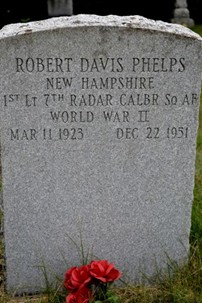
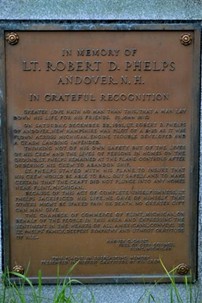
Robert Davis Phelps tombstone front and back
The pilot, 1st Lt. Robert Davis Phelps, did receive recognition from the city of Flint, Michigan. On the back of his memorial headstone in Andover, New Hampshire, is a bronze plaque with the following inscription:
In Memory of Robert D. Phelps – In Grateful Recognition
Greater love hath no man than this that a man lay down his life for his friends. On Saturday, December 22nd, 1951, Lieutenant Robert D Phelps of Andover, NH, was pilot of a B-29 as it was flown across Michigan. Engine trouble developed, and a crash landing impended.
Thinking not of his own safety but that of the lives of his crew and the lives of the persons in homes on the ground. Lieutenant Phelps remained at the plane controls after ordering his crew to abandon ship.
Lieutenant Phelps stayed with the plane to ensure that this crew would be able to bail out safely and to make certain that the craft did not plunge into any homes near Flint, MI.
Because of this act of complete unselfishness, Lieutenant Phelps sacrificed his life. He gave of himself that others might be spared pain or death. No greater gift can man give.
The Chamber of Commerce of Flint, MI, on behalf of the people in this area, and expressing the sentiment in the hearts of all Americans, conveys to Lieutenant Phelps’ family deepest sympathy and utmost gratitude of all.
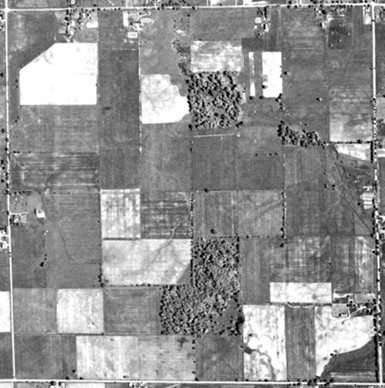
May 1953 aerial of the crash location shows no visual marks from the crash
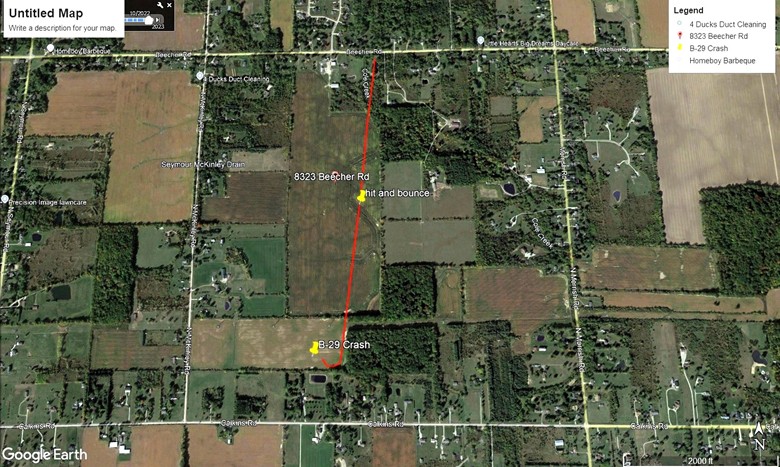
Overlay of the B-29 crash path onto the current Google Map of the area revealed that the aircraft came to rest at the derived coordinate of 43° 1’4.09″N 83°50’42.64″W
The crash site location was investigated and found to be currently under cultivation with farm crops. A further search of the exact location using a metal detector is planned once the crop is harvested, with permission from the farmer. The current farmer is Dieck Farms, based in Swartz Creek, MI. There are most likely some small artifacts in the field where the aircraft crashed and where it was later disassembled in the deep snow.

The field where the B-29 bomber crashed and came to rest
In conclusion, a presentation was made to the Experimental Aircraft Association Chapter 77 in Flushing, Michigan, in June 2025. The presentation answered all the community members’ questions about the accident. The accident was most likely caused by ice in the fuel system. The accident board tried to blame the Flight Engineer, but he was ultimately cleared. The pilot was never rewarded by the Air Force for his actions, but he was honored by the City of Flint. It is also hoped that this story will help honor the pilot’s memory and his actions. This accident is now remembered, and the lost history is now documented.
Epilogue: The pilot’s daughter, Victoria Phelps Stickney, died on 25 June 2025. The same date that this story was completed.