History, Architecture & Community Legacy
The Flushing depot, built in 1888 as a state-of-the-art railway station, has stood at the heart of Flushing’s history for well over a century. Erected during a railroad boom, this picturesque 19th-century depot was renowned as one of the finest small-town stations in Michigan. Over the decades, it evolved from a bustling transportation hub that transformed Flushing’s economy and social life, to an abandoned, fire-damaged relic, and finally to a proudly restored community museum and cultural center by 1997. Below is a summary of the depot’s most significant milestones:
Origins of the Depot and its 1888 Construction
Flushing’s quest for a railroad began in the mid-1800s, as local leaders organized committees and raised funds to attract a rail line to their community. Several proposed routes and charters fell through after the Civil War, despite enthusiastic support from Flushing businessmen like Arthur Andrus and David Sanford. Finally, in 1887, success arrived in the form of John Ashley’s Toledo, Saginaw & Mackinaw (TS&M) Railroad, which agreed to build a line through Flushing as part of a new route from Durand to Saginaw (later extended to Bay City). Local residents approved bonding and fundraising to meet the railroad’s conditions (raising $25,000 and donating land for a depot), ensuring Flushing would be included on the line.
Construction of the Flushing depot began in June 1888 under railroad building superintendent Edward Hubbard. The chosen site was at the west end of Main Street on the south side, just west of merchant Henry H. Chatters’ home. By July 18, 1888, the track construction train reached Flushing, touching off a jubilation described as one of the greatest celebrations in local memory. Townspeople fired cannons, rang church bells, and paraded in the streets when the “iron horse” arrived. Some bold residents even hopped aboard the slow-moving work train to become the first people to ride a locomotive into Flushing – including Mrs. A.D. Hosie, young Eva Paton, and others. Regular passenger service commenced in December 1888 (with the inaugural passenger train arriving from Saginaw on December 17, 1888).
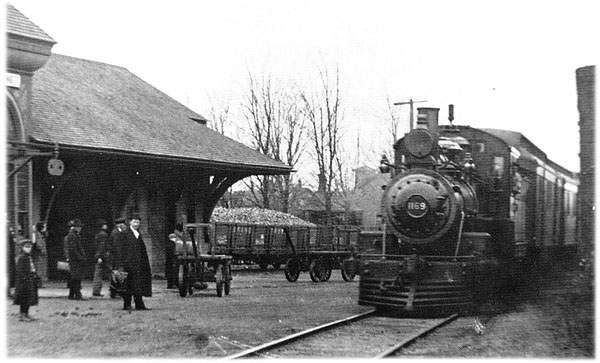
Architectural Features of the 1888 Depot
The Flushing depot’s design was considered exceptional for a town of its size. Plans called for a one-story wood-frame station measuring 70 feet by 24 feet on a foundation of local stone and brick. The depot’s interior was finished in hardwood and featured elegant stained-glass “cathedral” windows – a touch of Victorian style that impressed residents. The layout included a spacious central waiting room divided into two sections, with separate seating areas for “ladies” and “gentlemen,” each warmed by its own potbelly stove and even outfitted with brick fireplaces on the north and south walls. An enclosed ticket office was situated in the waiting area, and on the south end of the building a distinctive open pass-through breezeway allowed passengers and baggage carts to cross through the structure. Beyond this breezeway on the south end was the baggage room for freight and express shipments.
This depot was built as one of the larger and finer stations on the TS&M line. Railroad official P.H. Ketchum touted that “next to East Saginaw’s depot, [Flushing’s] will be the finest on the line… no other to compare with it” in a town of Flushing’s size. Indeed, the company invested about $5,000 in constructing Flushing’s station, a considerable sum in 1888, reflecting high expectations for the city’s growth.
A Boost to Flushing’s Growth and Economy
The new railroad – later operated by the Grand Trunk Western Railway – immediately transformed Flushing’s fortunes. In the late 19th century, the depot became a vital hub that connected the previously isolated village to regional markets. Dozens of local businesses sprang up or expanded to capitalize on rail access. For example, a large Flushing grain elevator and stockyards were built adjacent to the depot in 1888 to ship out local farm products and livestock. Within weeks of opening, freight shipments were booming: one contemporary account noted over 2,000 barrels of apples went out via the Flushing freight house in a single week during harvest season. The Flushing Roller Mills (Hart & Clarke’s flour mill) quickly became one of the railroad’s best customers, sending thousands of barrels of flour by rail.
With four passenger trains a day stopping in Flushing at its peak, the depot also made travel and commerce far more convenient. Local postmasters switched mail delivery to the trains in 1889, replacing the old stagecoach route. Salesmen could easily reach Flushing by rail to sell goods, and residents could visit distant cities or recreation spots like Bay City for day trips. The arrival of the railroad was thus celebrated not just as a transportation improvement but as a catalyst for economic optimism and connectivity to the wider world.
Community Focal Point in the Early 1900s
During the early 20th century, the Flushing depot remained a center of community life. Locals often visited the station simply to socialize and observe the steady procession of trains and travelers. The waiting room – with its twin men’s and women’s sections – became a cozy gathering place, especially on winter days, thanks to the glow of its pot-bellied stoves and fireplaces. Farmers stopping by with horse-drawn wagons could warm themselves, and children loved to watch the station agent at work, listening to the click of the telegraph key and marveling as he snatched mail pouches from passing trains with a hook.
The depot also hosted notable events. In 1908, for instance, Pilbeam’s Circus arrived in Flushing by train, transforming Main Street into a bustling carnival midway. World events echoed at the station as well: during the Great Depression, “hobos” riding the rails would sometimes hop off in Flushing, prompting the local night watchman to detain them or chase them off with a buggy whip – a testament to the depot’s role in the broader phenomenon of “riders of the rails” in that era.
By the 1910s and 1920s, the automobile’s rise began to challenge rail travel, and the depot saw changes. In 1912, Grand Trunk remodeled the interior to add “modern conveniences,” including updated restrooms, and reaffirmed the separation of men’s and women’s areas in the waiting room. Passenger traffic declined as cars and trucks took over local transportation, but freight business remained steady through the 1940s, with sugar beets, lumber, coal, and other commodities flowing through the Flushing freight facilities. Flushing’s longtime station agents, notably Frank Perkins (who served from 1890 to 1913) and Grover “Bud” Roof (1919–1944), kept the depot running efficiently through these years.
Decline of Rail Service and Mid-20th Century Changes
After World War II, railroad usage continued to wane nationwide. Flushing’s depot narrowly escaped demolition in the mid-1960s. In 1965, Grand Trunk Western considered closing and razing the building as a cost-cutting move, since passenger patronage had become minimal. Thanks to the advocacy of station agent Clare Fox – a Flushing native who had worked for the railroad since 1917 – the company reversed course. Clare Fox’s intervention in 1966 convinced Grand Trunk to keep Flushing depot open and in use, making some modest renovations to reduce maintenance costs. As part of this “reprieve,” the railroad removed or replaced some historic features: the original colored cathedral-glass windows were taken out and substituted with plain glass, and the distinctive bay-style agent’s window was altered and set flush with the wall during a repainting of the building. Nevertheless, Fox’s efforts ensured the depot remained intact and staffed as a freight agency and telegraph office into the early 1970s.
By May 1971, all remaining passenger service to Flushing finally ended when Grand Trunk joined Amtrak and discontinued its local trains. The railroad continued to use the line for freight, but without passenger trains the depot’s days as a transportation hub were numbered. Clare Fox retired in 1971 as Flushing’s last station agent, marking the end of an era. The very next year (1972), Grand Trunk shut down passenger operations on two of its Michigan branch lines, and Flushing’s depot was essentially closed for regular railroad business.
Grand Trunk sold the depot in 1973 to local investors, having little use for the building once rail operations were curtailed. Fortunately, this was not the end for the landmark. In 1975, entrepreneurs Harry Herman and Robert Myers opened the “Depot Restaurant” in the historic station. To accommodate its new function, they enclosed the open central passageway and constructed a brick kitchen addition on the building’s southeast corner, while decorating the dining area with railroad memorabilia and some of the depot’s original fixtures. For a few years, the old waiting room came alive again – not with train passengers, but with local diners enjoying the nostalgic ambiance. The Flushing Area Historical Society (formed in 1973) even held its first annual awards dinner at the Depot Restaurant in 1975, demonstrating how beloved and significant the site remained to the community.
Disaster and Decline in the Late 1970s
The late 1970s brought a series of blows to the Flushing depot. On December 6, 1978, a freight train derailed right in front of the station, very nearly causing catastrophe. Several railcars jumped the tracks near the adjoining freight warehouse; two tanker cars toppled over, with one coming to rest pointed directly at the depot’s platform. Fortunately, no one was injured and the depot itself wasn’t struck, but the accident tore up sections of track. In the cleanup, Grand Trunk seized the chance to remove most of the sidings around the depot that were no longer needed, leaving only the single main line track through town and a short spur to a local lumber yard. Shortly after, by 1978 the railroad tracks serving the depot were largely removed or truncated as the Flushing line was phased out of service.
In 1979, with the depot’s future uncertain, a bright spot emerged: the site was officially listed on the Michigan State Register of Historic Sites, recognizing its historical importance. A state historic marker was approved, making the Flushing depot one of only a handful of protected historic structures in the community at that time.
Tragically, disaster struck on April 20, 1980. Late that Sunday night, a fire broke out in the depot’s restaurant kitchen (likely due to faulty electrical wiring). The blaze rapidly spread into the attic and roof structure, which featured multiple levels and corners that proved difficult for firefighters to access. Despite the efforts of crews from Flushing and neighboring towns, the inferno gutted the building’s interior, causing the heavy timber roof to collapse and reducing the once-grand depot to a charred shell of walls open to the sky. The historic landmark was left a “sorry sight,” with only the sooty brick and stone exterior and a portion of the northwest roof section still standing. After the fire, the Depot Restaurant closed permanently, and its proprietors moved their business elsewhere in town. For the next several years, the ruined depot sat abandoned and exposed to weather, as legal questions and lack of funds left it in limbo.
Rescue and Restoration by the Flushing Area Historical Society (1980s–1990s)
The devastation of the 1980 fire turned the Flushing depot’s fate over to the emerging local preservation community. The Flushing Area Historical Society (FAHS) – founded in 1973 by residents led by Lois H. Bettesworth – immediately recognized the importance of saving the depot. Society members had long dreamed of establishing a local history museum, and the depot seemed an ideal site if it could be reclaimed. Negotiations with the depot’s private owners culminated in an agreement: the owners would donate the burned-out depot “as-is” to the Historical Society, provided it be used for public benefit (and not sold for profit). On February 27, 1984, the deed transfer was officially recorded, and the Society took possession of the derelict structure.
Community volunteers, local businesses, and civic leaders then united in an extraordinary restoration effort. Under the leadership of FAHS President Paul W. Wightman, a retired educator, the Society began raising funds, securing grants, and rallying hands-on support to rebuild the depot as a museum and cultural center. The restoration unfolded in careful phases: first stabilizing and roofing the structure, then reconstructing the exterior to its original 1888 appearance, and finally rebuilding the interior to serve new purposes.
Roof & Exterior: In 1985–86, contractors rebuilt the depot’s intricate Victorian-style roof exactly to the original design, even reconstructing a north portico (canopy) that had been removed decades earlier. New cedar shingles in a period-appropriate stone-gray color were installed to match surviving samples. By September 1986, the structure was weathertight under a brand-new roof. In 1987–88, the exterior walls, doors, and windows were restored. The station agent’s bay window, which had been altered in the 1960s, was rebuilt in its original 19th-century configuration, and a large arched window was added to enclose the once-open pass-through (creating an indoor gallery space). Volunteers even succeeded in saving the 1888 wooden freight warehouse (or “freight shed”) that had stood beside the depot: in 1987 it was carefully moved about 200 feet and relocated directly behind the depot so that both structures could eventually form a joint museum complex.
Interior & Finishes: From 1988 through 1995, work continued on the depot’s interior, guided by architect Ronald Campbell. The goal was to restore the interior ambiance of the 1888 station while adapting it for museum use. Original materials were salvaged and reinstalled wherever possible – for instance, the brick archway between the waiting room and breezeway (badly weakened by the fire) was carefully shored up and rebuilt to preserve its historic appearance. The hardwood floors and beadboard ceilings were reconstructed in the original style, and the two fireplaces were restored. Modern systems (heating, plumbing, electrical) were discreetly added, and restrooms and a small kitchenette/library were created in the former baggage and kitchen areas to support the building’s new function. In an event celebrating the progress, the Society held an open-house at the partially restored depot in September 1986, inviting the public to see the work in progress and igniting further community support.
This massive volunteer-driven project received widespread recognition. In 1989, the first public cultural event – a student art show – was held inside the unfinished depot, drawing 400 attendees and proving the venue’s potential as a community center. In 1990, the Historical Society of Michigan honored the Flushing Area Historical Society with an Award of Merit for the depot restoration, calling it an outstanding achievement in historic preservation. By May 1991, the Society had raised a remarkable $250,000 (a quarter-million dollars) in grants and donations – meeting its initial fundraising goal to complete the depot’s rebuild. In a surprise ceremony that month, the depot’s beautifully restored north waiting room was dedicated as the “Paul Wightman Gallery” in honor of the Society president who led the project, with a painted portrait of Mr. Wightman unveiled above the old fireplace mantle.
Finally, after 13 years of determined labor, Flushing’s beloved depot was reborn. The fully restored Flushing Area Museum & Cultural Center opened its doors on June 7, 1997, with a grand opening celebration attended by local dignitaries and the Historical Society’s members. The once-ruined station had been transformed into a local history museum, art gallery, and event space – bringing new life to the old building. Shortly afterward, work also commenced to renovate the 1888 freight shed (now positioned adjacent to the depot) as part of a larger complex, with plans to use it for additional exhibit and community space.
Legacy and Community Role
From its inception, the Flushing depot served not just as a transportation facility but as a social and economic engine for the community. In the late 19th century, the depot’s presence spurred commercial growth – from enabling local farmers to reach broader markets to attracting new industries like lumber yards and canning factories near the tracks. The “railroad boom” era fundamentally changed daily life in Flushing: as Volume III of the Flushing Sesquicentennial History notes, “arrival of the railroad brought a time of business expansion, optimism and celebration… nothing… rivaled the celebration greeting the iron horse in 1888”.
In the first half of the 20th century, the depot remained a busy civic focal point. It was the site of routine comings and goings that bound Flushing to the outside world and to each other – whether commuters catching trains, farmers chatting around the stove, or children marveling at the sights and sounds of steam locomotives. Even as automobiles and highways eclipsed railroads, the depot symbolized Flushing’s heritage and identity.
After rail service ended, the community’s attachment to the depot only grew stronger. The 1970s restaurant chapter demonstrated how locals re-purposed the landmark for new uses, keeping it relevant. The disastrous 1980 fire could have meant the end – but Flushing’s citizens, through their Historical Society, refused to let the story finish there. The ensuing restoration became a community-wide endeavor that not only preserved the building’s historic fabric but also built new civic pride. Today, the Flushing Depot (as the Flushing Area Museum) once again serves the public – hosting exhibits, meetings, art shows, and educational events much as it hosted travelers and townsfolk in its heyday. The Historical Society’s vision to use the depot as a “bridge from the past to the present and into the future” has been realized.
Notable Figures Associated with the Depot:
Albert R. Ransom (1852–1931) – Editor of The Flushing Observer newspaper, he championed the cause of bringing a railroad to Flushing. Ransom’s stirring editorials in 1887 urged citizens to support John Ashley’s planned rail line, calling it “our last opportunity… the one that will make the town grow and prosper”. His advocacy helped galvanize local funding and enthusiasm for the depot’s construction.
John B. Ashley – Railroad entrepreneur and president of the TS&M Railroad, whose decision to “bend the rails” eastward to include Flushing secured the town’s rail connection. In 1887, Ashley negotiated the financial terms for routing his line through Flushing (demanding $25,000 and depot grounds from the community). Under his leadership, the line was built and the Flushing depot opened in 1888.
Clare A. Fox (1898–1987) – The tenth and last station agent at Flushing, serving from 1944 until 1971. A lifelong Flushing resident, Fox was instrumental in saving the depot from closure in 1966. When Grand Trunk considered demolishing the underused station, Fox’s efforts convinced the railroad to keep it open, albeit with some modifications (such as removing the ornamental glass windows). His successful advocacy gave the depot a second life and more time – enabling its later preservation.
Paul W. Wightman (1913–2007) – President of the Flushing Area Historical Society during the 1980s–90s and the driving force behind the depot’s restoration. Wightman organized the fundraising campaign, coordinated volunteers and contractors, and kept the dream of a museum alive. In gratitude, the Society named the depot’s former waiting room the “Paul Wightman Gallery” in 1991 and presented him with a commemorative portrait hung above the fireplace.
Lois Haight Bettesworth (1926–2014) – Founding president of the Flushing Area Historical Society in 1973. Bettesworth was a key leader in preserving Flushing’s heritage; she helped spearhead the Society’s publication of two local history volumes and guided early restoration planning for the depot. She is credited with initiating the Society’s involvement in the 1976 U.S. Bicentennial celebrations and laying the groundwork for later projects.
In summary, the Flushing depot’s story is one of resilience and adaptive reuse. From its golden age in the railroad era, when it was built as an architectural gem that spurred local prosperity, through the challenges of the automotive era and near-abandonment, to its rebirth as a museum, the depot has remained a centerpiece of Flushing’s identity. Its preservation stands as a testament to the community’s dedication to honoring local history and repurposing their heritage landmarks for future generations. The Flushing depot, once a hub for trains and travelers, is now a cherished cultural and historical hub – a place where the past is celebrated and shared with the community and visitors alike.