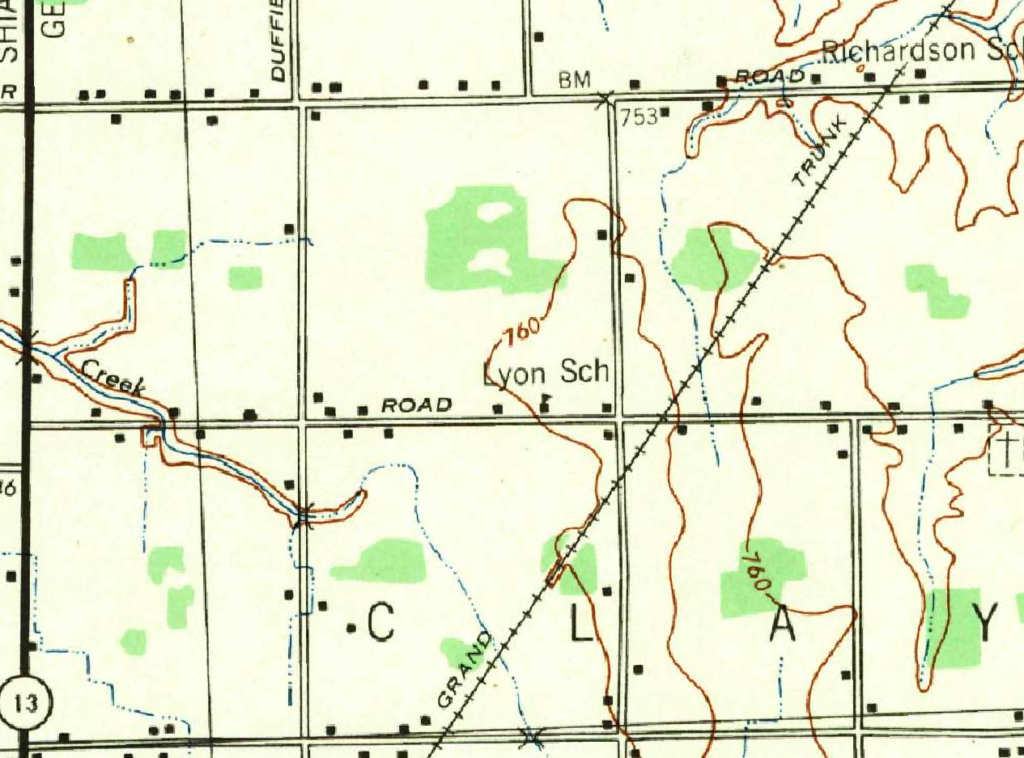
Lyon School was a one-room rural school in Flushing Township, Genesee County, Michigan, that served the farming community known as Lyons Settlement (an area around Beecher Road in the southwest part of the township). Established in the mid-19th century as District Number 8, it was named for the pioneering Lyons family – notably brothers William, Isaac, Daniel B., and Abraham Lyons – who were among the earliest settlers in the area. Over its roughly century-long existence, Lyons School underwent several rebuilds, educated generations of local children in a single-room setting, and functioned as a social hub for its rural neighborhood. Below is a comprehensive look at its history, architecture, community role, and ultimate fate, compiled from the Flushing Area Historical Society archives and related sources.
Origins of Lyons Settlement & School Formation (1830s–1850s)
The Lyons Settlement took root in the 1830s, when members of the Lyons family migrated from New York and purchased land in Flushing Township. Isaac Lyons, Sr. arrived in 1835 and carved out a farm in the dense woodlands (Section 8 of neighboring Clayton Township). Soon other relatives and settlers joined – including James Lyons (Isaac’s brother, who bought government land in 1836), William Lyons, Daniel B. Lyons, and families like the Burbridges, Ottaways, and Fenner (often spelled Fenner or Finner) – establishing a small farming community along what became Beecher Road. This vicinity, initially called Lyons Settlement, would later also be nicknamed the “Irish Neighborhood” as Irish immigrant families (e.g. the Lennon and Conlin families) moved in.
Education was a priority for these pioneers. At Flushing Township’s very first meeting in 1838, residents set aside funds to support local schools. True to that ethos, the Lyons Settlement families organized District No. 8 and by the early 1840s established a small school for their children. The exact founding year of Lyons School is not documented precisely, but it’s known that by 1844 the school existed and was formally referred to as the “Lyons” school, honoring the Lyons brothers. Initially, classes may have been held in a crude log structure or even a room in a settler’s home. In fact, one account notes that the very first makeshift school in the district was set up on Isaac Lyons’s land and reputedly cost only about $10 – likely a simple log cabin or repurposed building used to start holding classes for local children.
By the mid-1840s, the community upgraded to a purpose-built schoolhouse. In 1848 the first wood-frame school building for District 8 was constructed at a cost of $200. This modest investment created a classic one-room schoolhouse of the era: a single-story frame structure clad in wood, with a gabled roof and likely a single central entrance. Like most rural schools of the time, it would have had tall windows on the sides for light, a wood-burning stove for heat, and probably a bell mounted above the door or on a small belfry to summon children from the surrounding farms. The school’s location was along Beecher Road in Flushing Township – near today’s intersection with Elms Road – placing it conveniently for families living in that quadrant of the township. The district’s first teacher on record was Angeline Smith, a young woman who likely taught all subjects and grade levels alone in that one room.
Development and Changes (19th Century)
As the 19th century progressed, Lyons School remained a cornerstone of local life in Flushing Township’s District 8. By 1850, the district’s operations were formalized with local governance – notably, Isaac Lyons, Jr. (son of Isaac Sr.) was appointed as the Director and Assessor of District #8 in 1850, reflecting the Lyons family’s continuing leadership in school affairs. The school served children roughly aged 5 through 15 (1st to 8th grades equivalent) from all the nearby farms. Enrollment in those early years was small: one report indicates there were only 18 pupils attending in the 1840s, underscoring the intimate scale of education.
Architecture & 1881 Rebuild: The original 1840s frame schoolhouse sufficed for several decades, but by the late 19th century it likely showed wear or had become too small. In 1881, the district erected a new building for Lyons School at a cost of $850 – a substantial upgrade that suggests a larger or more refined structure. This 1881 schoolhouse, too, was a one-room design, almost certainly wood-framed as well. It may have been built on the same site or very nearby. An old reminiscence in the Flushing centennial history described Lyons School as a typical country schoolhouse, with rows of desks facing a central chalkboard, heated by a potbelly stove in the center, and decorated with the American flag and perhaps portraits of George Washington and Abraham Lincoln on the walls. One corner might have had shelves for a small library or recitation bench, and the entryway a place for coats and lunch pails. In essence, the 1881 Lyons School would have looked much like the iconic little red (or white) schoolhouses of American lore. No known photograph of Lyons School survives in the public Flushing archives; in later historical retrospectives, Lyons School is notably absent from group photos of old Genesee County schoolhouses, with a note that it had “burned” before such records could be made.
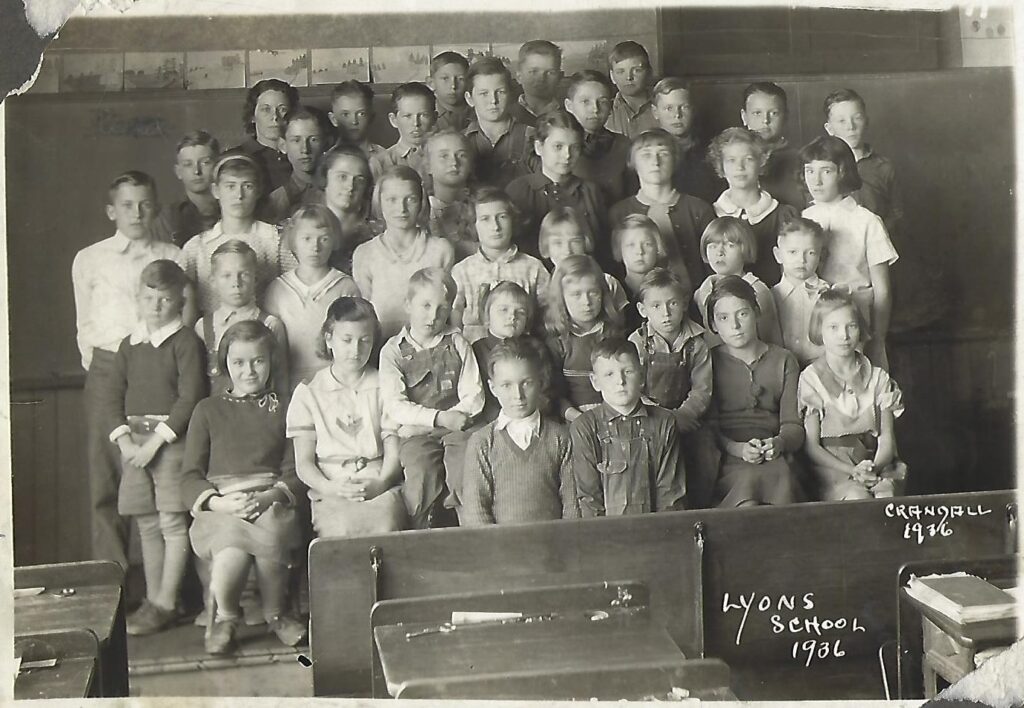
By 1903, Lyons School was still operating robustly. Records from that year indicate the district’s population was about 123 people, with 42 students enrolled in the school (some families had many children attending together). These numbers show growth from the mid-century and reflect how the school kept pace with the community’s needs. Even as the 20th century dawned, the school remained a single-room institution, largely unchanged in its methods – children in primer levels through 8th grade recited lessons at the front while older students studied independently, and the teacher managed every subject. Former pupils later recalled walking miles to Lyons School, carrying lunch pails, and how the schoolyard was the scene of baseball games, snowball fights, and Friday afternoon elocution contests.
Decline, Consolidation, and Closure (1940s–1950s)
The mid-20th century brought significant change to rural education across Michigan, and Lyons School was no exception. After World War II, Michigan pursued school district consolidation aggressively, aiming to improve education by merging tiny rural schools into modern centralized schools in town. In the Flushing area, a consolidation program began around 1946 under Superintendent Marion Crouse. Over the next few years, Flushing’s remaining one-room schools were gradually absorbed: some closed in 1949, and others (including Lyons) in 1950.
For Lyons School, the last school year was 1949–50. In the summer of 1950, District #8 (Lyons) officially joined the Flushing Community Schools system. The few students still attending Lyons were henceforth bused into Flushing’s town schools (by then, Flushing had a consolidated elementary and high school). Lyons School’s closure marked the end of an era – after roughly a hundred years, the little schoolhouse by Beecher Road fell silent.
At the time of consolidation, the building was already aging. There is evidence that Lyons School may have even closed slightly earlier due to dwindling enrollment, operating perhaps sporadically in its final years if student numbers were low. Regardless, by 1950 it was permanently closed as an educational facility. The building and property likely reverted to the township or was sold off. Some one-room schoolhouses in the region found second lives as community centers or private residences – but Lyons School did not get such a reprieve. Tragically, within a few years after closing, the Lyons School building was destroyed by fire. The exact date of the blaze isn’t recorded in the archives, but a Flushing sesquicentennial publication later noted that Lyons School had “burned” – as had the Hurd School – and thus no photograph could be included. This suggests the fire occurred sometime in the 1950s, likely making the structure a total loss.
Legacy and Significance
Though gone, Lyons School holds an enduring place in local history and memory. It exemplifies the evolution of public schooling in rural Michigan: from the early pioneer days when settlers like the Lyons prioritized education even “though it was no more than a room in [a] small home in the woods”, through the era of neighborhood one-room schoolhouses that educated generations in basic skills, and finally into the modern age of consolidated schools. The fact that Lyons School existed at all in the 1840s speaks to a broader trend in the Flushing area – the commitment to learning and civic building by pioneer families. These were people who, often with limited means, nonetheless erected schools as soon as there were children to teach, reflecting New England traditions they brought west.
In the context of Flushing’s development, Lyons School was one of about a dozen rural schools that ringed the central village. Each served its immediate farming district and was a microcosm of its community. Lyons School, in particular, bore the name of one of the area’s most influential settler clans, ensuring that the Lyons family’s contributions would be remembered. The Lyons Settlement area itself eventually lost its identity as a separate hamlet, becoming simply part of greater Flushing Township, but the school’s name recorded that heritage on maps and in records for a century. Interestingly, when lists of Flushing Township school districts were compiled in 1930s histories, District 8 (Lyons) is noted alongside other districts like Warner, Caldwell, Cronk, etc., which hints at how each was an important unit of community organization in the 19th century.
Today, Lyons School is remembered through historical writings and the descendants of those who studied there. The Flushing Area Historical Society’s archives (such as C. O. Hart’s “Historical Sketch of the Lyons School” written in 1935) preserve details of the school’s timeline, and occasional mentions in local memoirs keep its story alive. The school’s absence from the landscape serves as a reminder of how much changed in the 20th century.
In summary, Lyons School near Flushing, MI began as a humble pioneer school in the 1840s, flourished for decades as a center of learning and community for the Lyons Settlement, and bowed out mid-20th century as education consolidated, literally ending in flames. Its legacy is an integral chapter in the narrative of Flushing’s rural heritage, symbolizing both the resourcefulness of early settlers and the relentless march of progress in educational infrastructure.