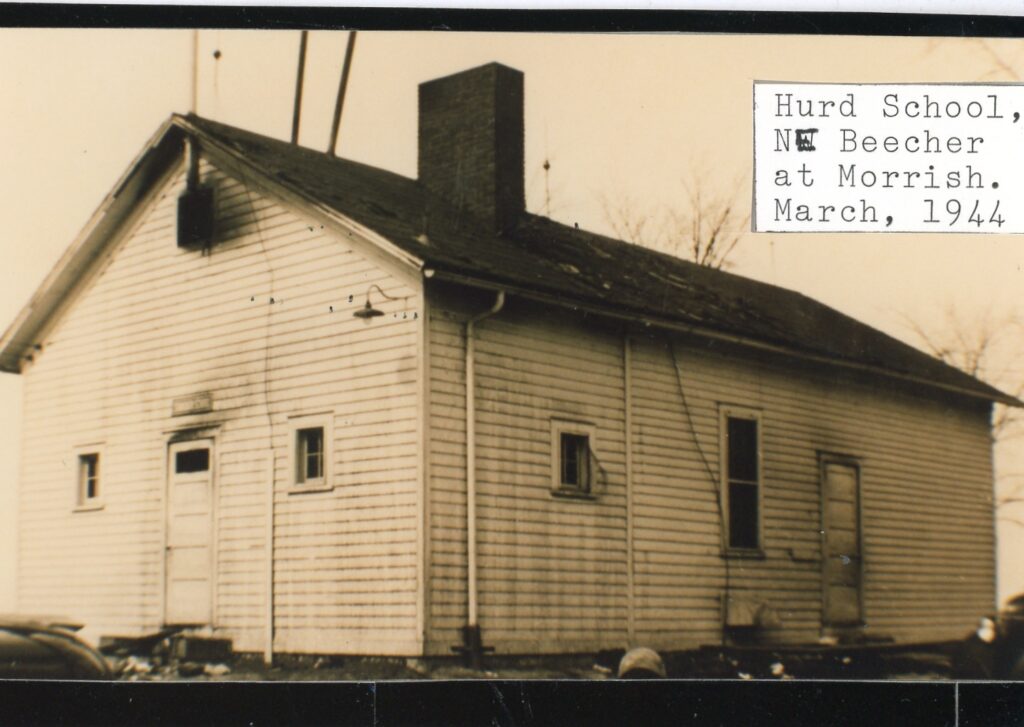
Hurd School was one of the rural one-room schoolhouses that served Flushing Township in Genesee County, Michigan. It was located in the southwestern part of the township, near the intersection of Beecher Road and Morrish Road, in an area that an 1850s map labels as “Valeria” (a short-lived local post office). This suggests that Hurd School was the educational center for families in the vicinity of Beecher and Morrish Roads, a region that bordered Clayton Township to the south. The school derived its name from the Hurd family, early settlers in the area. One notable member was Russell G. Hurd, who is recorded among the prominent Flushing pioneers (listed in an 1858 meeting of local notables). The Hurd family likely donated land or significantly contributed to establishing the school, hence the naming of the district as “Hurd.”
Founding and Early Years
Hurd School was probably established around the mid-19th century, as Flushing Township’s population grew and the need for local schools increased. In the 1830s and 1840s, the township was divided into numbered school districts, each serving children in particular areas. It’s believed Hurd School was originally District No. 12 of Flushing Township (though some sources suggest it might have been District 14; early records are not completely consistent). The first structure for Hurd School was almost certainly a small, wood-frame one-room building, built on a parcel of land that perhaps jutted west of the old road alignment near Beecher Road.
This original building for Hurd School likely went up sometime in the late 1840s or early 1850s, similar to other rural schools in the region — for instance, Lyons School (District No. 8) built its first permanent building in 1846. We do not have an exact date for Hurd School’s first construction, but given the surge of settlement in the area by 1850, a reasonable estimate would be the early 1850s. Like its counterparts, this first Hurd School would have been very modest: basically a shack with a single door and a few windows, heated by a wood stove, with rough-hewn benches or desks inside. Community recollections compiled by the Flushing Historical Society indicate that a school existed on “John Paton’s farm” by 1859, with another marked at Beecher & Morrish (Hurd’s site) on that same map. This confirms that Hurd School was operational by the 1850s.
Community and Hurd Family Connections
The Hurds were associated with Flushing Township’s early development. Russell G. Hurd in particular appears in an 1858 list of speakers at a Genesee County pioneer gathering, underscoring that the family was well known locally. It’s plausible that Russell or his kin offered the land for the school or led the effort to build it. The school would have served children from families such as the Hurds, as well as neighbors like the Youngs, Patricks, and other early farming families in southwestern Flushing Township. That area was partly rural and partly swampy, and an early post office named Valeria suggests a small hamlet existed there around the mid-19th century. The presence of the school near Valeria indicates Hurd School likely served as both the educational and social hub for that little community.
School Buildings & Improvements
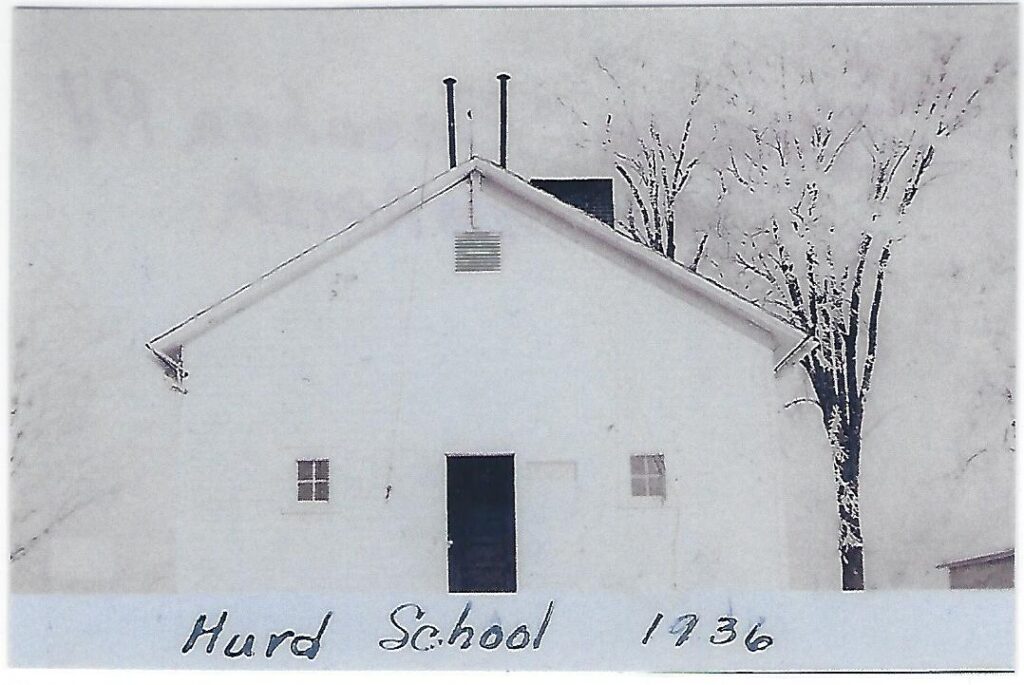
By the late 19th century, many one-room schools saw upgrades or replacements. Hurd School appears to have been rebuilt or improved at least once. Though specific records of construction costs or dates for Hurd are sparse, we can infer from analogous schools that a new Hurd School building was likely constructed around the 1870s or 1880s. For example, Lyons School built a new structure in 1881 at $850, and the Caldwell School (another Flushing rural school) was erected in 1869. It’s reasonable that Hurd School followed suit with a more substantial building by the end of the 19th century. If a new building was built, it would have remained a single-room frame schoolhouse, probably with clapboard siding and possibly a small belfry for a bell.
Inside, Hurd School had the typical layout: one teacher’s desk at the front, rows of wooden desks for students, a blackboard on the wall, and a potbelly stove in the center for heat. Students in grades 1 through 8 shared the room, and older children often helped the younger ones in their lessons. The school likely had outdoor privies (one for boys, one for girls) and a hand pump or a well for water. A flagpole might have stood out front, as patriotism was a strong element of school life, especially in the early 20th century. The school day would start with the ringing of the bell and perhaps a patriotic song or recitation.
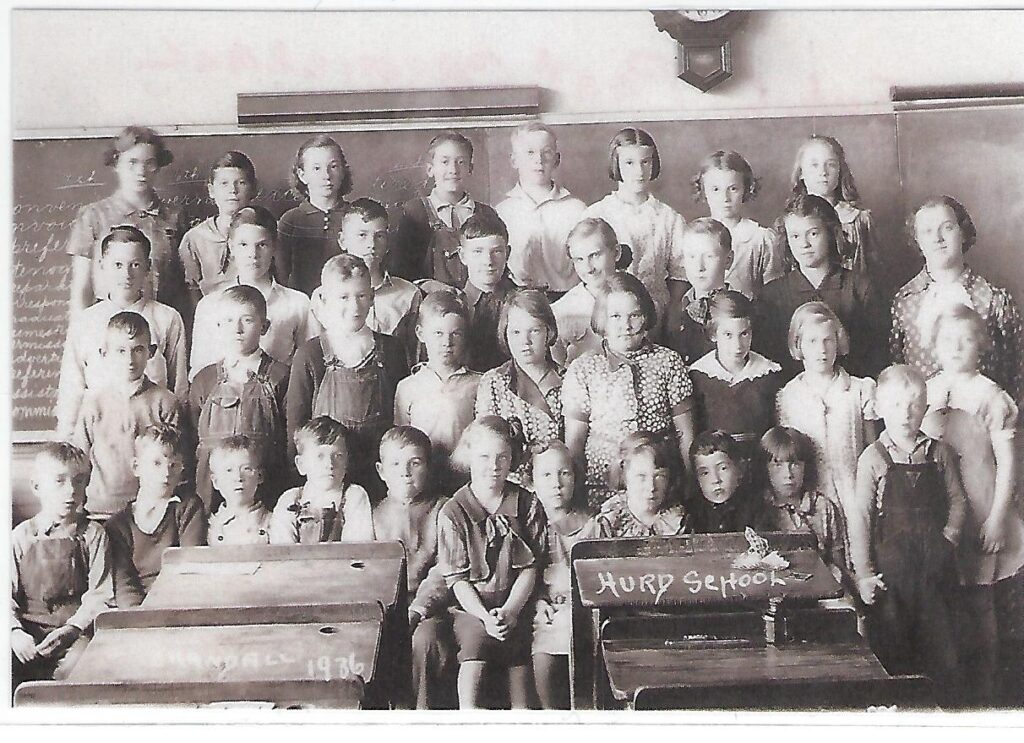
People and Stories: The names of specific teachers and students at Hurd School are not fully documented in surviving texts, but we can surmise a few. Early Flushing school records mention persons like Jeremy Miller and Irving Bailey as the first school inspectors in the township (responsible for examining teachers and issuing teaching certificates in the 1840s). The first teaching certificate, for instance, was issued to a Miss Serena Chamberlain, which indicates qualified young women were being employed to teach in these schools. It’s likely that Hurd School’s initial teachers were similarly young local women or men—sometimes even older students who had gone on to get teacher training.
Role in the Community
Like other one-room schools, Hurd School played multiple roles. It was primarily an educational institution, but it was also used for community gatherings, such as seasonal festivals, town meetings, and possibly church-related functions or Sunday school in an era when churches were few and far between in the countryside. Oral histories in Flushing mention that rural schools often doubled as venues for social events and even voting. For instance, Flushing’s earliest Baptist congregation held meetings in local schoolhouses in the 1840s. Hurd School, being a focal point of its neighborhood, likely hosted occasional public meetings or served as a polling place for that district as well.
Later Years and Closure
The 20th century brought big changes. By the 1930s and 40s, many of these small schools saw declining enrollment as transportation improved and farming populations shifted. In Flushing Township, a sweeping school consolidation movement occurred around 1949–1950. According to an official history, Hurd School, along with four other rural schools, was consolidated into the Flushing Public Schools in 1949. This meant that after roughly a century of service, Hurd School closed its doors. Its remaining students were bused to larger schools in Flushing city or centralized township schools.
Fate of the Building
There are hints about what became of Hurd School’s physical structure after closure. A Flushing sesquicentennial book notes that the buildings of Hurd School and Lyons School both “had burned” by the time of that publication (c. 1970s). This indicates that some years post-closure (likely in the 1950s or early 1960s), the old Hurd School building caught fire and was destroyed. It was not uncommon for disused wooden schoolhouses to suffer such fates, whether due to accidental fires or intentional burning as a method of demolition.
Legacy and Significance
Hurd School’s story, though sparsely documented, is emblematic of the pioneer commitment to education. Its establishment gave structure to a community of farmers, providing a place where children learned the basics of reading, writing, and arithmetic, and where neighbors strengthened social ties. The Hurd family name is preserved in local lore primarily through the school; while Flushing’s village schools sometimes got official historical markers or were converted to other uses, the rural ones like Hurd live on only in memories and historical records.
In Flushing’s educational history, Hurd School was part of the tapestry of “Rural Districts” that were eventually knitted into one large district. A striking piece of evidence is an illustrated consolidation map which shows each rural school and its district number at the time of merging. In that depiction, Hurd School is grouped with Caldwell, Cronk, Graham, and Hopson as those absorbed in 1949. The legacy of these rural schools is honored in local history books and by the Flushing Area Historical Society, which has compiled accounts of each. These accounts ensure that even though the buildings are gone, the significance of the schools is remembered.
For the Flushing area, the end of Hurd School and its peers marked the transition from a rural farming community to a more suburban, centralized community. Yet, townspeople have kept the memories alive. In Flushing’s historical publications, each of the old rural schools – Caldwell, Cronk, Hopson, Kent, Hurd, etc. – is remembered with respect and nostalgia. They remain a symbol of the community’s roots: a time when neighbors banded together to ensure that every child, no matter how far from town, had a chance to learn. Hurd School, in particular, stands as a testament to the Hurd family’s influence and the value early residents placed on education and community, long before the era of paved roads and school buses made it easier to connect distant parts of the township