Jacob Kimmel Building: Difference between revisions
| (One intermediate revision by the same user not shown) | |||
| Line 2: | Line 2: | ||
== Jacob Kimmel Building (Flushing, Michigan) == | == Jacob Kimmel Building (Flushing, Michigan) == | ||
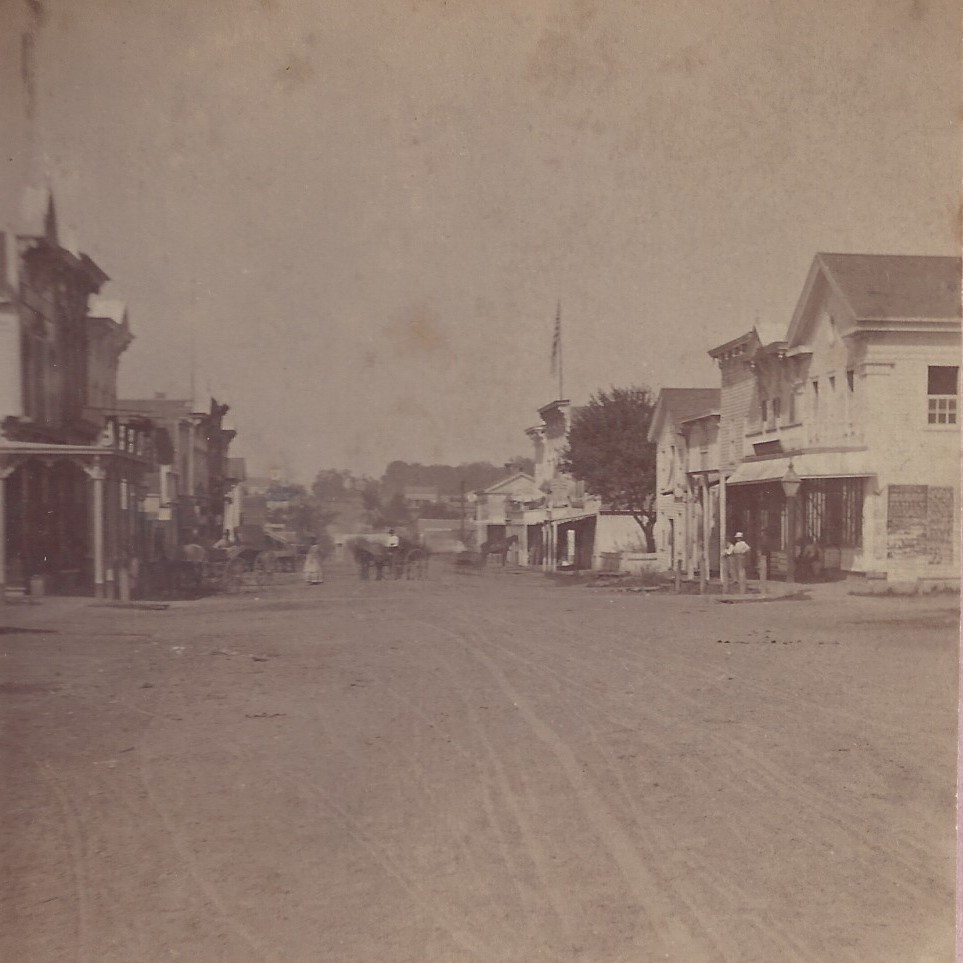
The Jacob Kimmel Building (also spelled Kimmell Building and historically associated with Corinthian Hall) is a two-story brick commercial building located at 135–137 East Main Street, Flushing, Michigan. Constructed as a wood-frame structure circa 1848–1850, it is among the oldest extant buildings in downtown Flushing and originally served as a blacksmith shop before becoming a center for civic and social life in the 19th century. The building is listed on the U.S. National Register of Historic Places as a contributing property in Flushing’s Main Street Historic Commercial District (NRHP listed June 20, 1983), reflecting its historical and architectural significance. | |||
The Jacob Kimmel Building | |||
=== History === | === History === | ||
The building was constructed | The building was initially constructed between 1848 and 1850 by John L. Green, a local blacksmith, who used it as a wood-framed blacksmith shop on the northwest corner of Main and Cherry Streets.1 In the late 1870s, Green modernized the small two-story structure by adding a brick veneer to the exterior walls, improving its fire resistance while preserving the original timber frame within.1 In 1880, prominent harnessmaker Jacob Kimmell (also spelled Kimmel) purchased the property and moved his harness and mercantile shop into the building’s first floor.1 The second floor, a spacious hall with high ceilings, was redecorated by Kimmell and renamed “Corinthian Hall.” This became the first public meeting hall in Flushing’s early years and was a popular venue for community events, civic meetings, social gatherings, cultural activities, and even political events.1 | ||
Numerous significant events in Flushing’s history took place in Corinthian Hall during the late 19th century. For example, Flushing’s very first high school commencement ceremony was held there in 1878, as it was the largest and only public hall available in town at the time.2 The hall also hosted Flushing’s earliest village elections and public meetings when the village was establishing its government (its first election precinct was set up in this building).2 Before Flushing built a dedicated fire station in 1884, the rear room of Kimmell’s harness shop in this building housed the village’s first firefighting equipment — a hand-drawn hose cart and chemical fire pumper — effectively serving as the town’s initial firehouse.2 | |||
By the 1880s and 1890s, as Flushing grew and new entertainment venues (like opera houses) appeared, Corinthian Hall gradually lost its central role. The upper hall was eventually converted into a private residence, while the ground floor continued as commercial retail space for various tenants.2 A 1930 business directory, for instance, lists a barbershop at 137 E. Main St. (the Kimmel Building’s address), indicating one of the building’s later uses.3 Throughout its existence, the Kimmel Building remained a Main Street fixture, undergoing periodic repairs – a 1931 local newspaper noted exterior brick repairs on what it called “one of the original pioneer buildings in town.”2 | |||
=== Architecture === | === Architecture === | ||
The Jacob Kimmel Building is a | The Jacob Kimmel Building is a two-story, three-bay commercial structure exhibiting Italianate architectural features typical of the late 19th century. Though originally built of wood, its exterior was brick veneered in 1891 (or earlier, late 1870s) to update its appearance and fireproofing.12 The original wood-frame structure still exists intact beneath this brick shell, making the building a rare surviving example of Flushing’s mid-19th-century wooden commercial architecture.25 The front façade, facing Main Street, is ornamented with pedimented pressed-metal window hoods above the second-floor windows and features an elaborate pressed-metal cornice with heavy bracketed corner posts, characteristic of the Italianate style.1 The brickwork includes a decorative pressed-brick horizontal belt course at the second-floor level, and the upper facade retains much of its original 19th-century appearance, despite the ground-floor storefront being modernized in the 20th century (including the addition of a shingled overhang).1 | ||
Corinthian Hall, the building’s second-floor auditorium, was known for its spacious interior and possibly some classical decorative touches (hence its name). While details of its interior decoration are largely lost, it was famed in its day as Flushing’s principal meeting place before purpose-built theaters and halls were erected.2 Its prominence also earned the entire building an enduring nickname; even after Jacob Kimmell’s ownership, the upper story continued to be called “Corinthian Hall.” The building’s corner location at Main and Cherry Streets, near the Flint River, further contributed to its local landmark status. | |||
=== Later Developments and Preservation === | |||
Following Kimmell’s tenure, the building saw various commercial occupants and adaptations over the decades. It remained structurally sound, and repairs were made as needed (for example, portions of the weathered east wall were re-veneered with brick in 1931).2 The significance of the Jacob Kimmel Building was officially recognized in the early 1980s during a historic preservation survey of Genesee County. It was identified as a pivotal contributing structure in Flushing’s downtown and became part of the “Main Street Historic Commercial District”, which was added to the National Register of Historic Places on June 20, 1983 (NRHP Reference #83000846).1 As a result, the Kimmel Building is protected as an element of this designated historic district. | |||
Local historians often highlight the building’s unique status as the oldest surviving commercial building in Flushing’s business district. The Flushing Area Historical Society noted that despite the brick façade concealing it, the original 1848-era wooden structure inside makes it “the only one of the pioneer wooden buildings [downtown] in existence” today.5 Community members have expressed hope that the building might one day be restored to reveal its early wooden architecture, further “bounding it back into history” by showcasing its 19th-century origins.2 As of the early 21st century, the Jacob Kimmel Building still stands at 135–137 E. Main Street, continuing to serve local businesses and reminding residents of Flushing’s pioneer heritage. | |||
=== Sources === | |||
1 - Main Street Historic Commercial District, Flushing – National Register of Historic Places Nomination (1983). National Park Service, U.S. Department of the Interior. (NRHP #83000846 – Genesee County MRA). [Building description and significance in nomination document, p. 35–36, 40–41.] | |||
2 - Flushing Sesquicentennial History, Vol. 3 (1998). Flushing Area Historical Society. [Historic events at Corinthian Hall and later alterations, p. 132.] | |||
3 - Directory of Flushing, Michigan (1930). [Listing of Fred A. Goyer’s Barber Shop at 137 E. Main St.] | |||
4 - Flushing Sesquicentennial History, Vol. 1 (1985). Flushing Area Historical Society. [Early use of Corinthian Hall, recognition of building’s survival under brick veneer, p. 62.] | |||
5 - Flushing Sesquicentennial History, Vol. 1 (1985). Flushing Area Historical Society. [Note on original wood building from 1848 still existing beneath 1891 brick, p. 62.] | |||
Latest revision as of 21:20, 23 February 2026
Jacob Kimmel Building (Flushing, Michigan)
The Jacob Kimmel Building (also spelled Kimmell Building and historically associated with Corinthian Hall) is a two-story brick commercial building located at 135–137 East Main Street, Flushing, Michigan. Constructed as a wood-frame structure circa 1848–1850, it is among the oldest extant buildings in downtown Flushing and originally served as a blacksmith shop before becoming a center for civic and social life in the 19th century. The building is listed on the U.S. National Register of Historic Places as a contributing property in Flushing’s Main Street Historic Commercial District (NRHP listed June 20, 1983), reflecting its historical and architectural significance.
History
The building was initially constructed between 1848 and 1850 by John L. Green, a local blacksmith, who used it as a wood-framed blacksmith shop on the northwest corner of Main and Cherry Streets.1 In the late 1870s, Green modernized the small two-story structure by adding a brick veneer to the exterior walls, improving its fire resistance while preserving the original timber frame within.1 In 1880, prominent harnessmaker Jacob Kimmell (also spelled Kimmel) purchased the property and moved his harness and mercantile shop into the building’s first floor.1 The second floor, a spacious hall with high ceilings, was redecorated by Kimmell and renamed “Corinthian Hall.” This became the first public meeting hall in Flushing’s early years and was a popular venue for community events, civic meetings, social gatherings, cultural activities, and even political events.1 Numerous significant events in Flushing’s history took place in Corinthian Hall during the late 19th century. For example, Flushing’s very first high school commencement ceremony was held there in 1878, as it was the largest and only public hall available in town at the time.2 The hall also hosted Flushing’s earliest village elections and public meetings when the village was establishing its government (its first election precinct was set up in this building).2 Before Flushing built a dedicated fire station in 1884, the rear room of Kimmell’s harness shop in this building housed the village’s first firefighting equipment — a hand-drawn hose cart and chemical fire pumper — effectively serving as the town’s initial firehouse.2 By the 1880s and 1890s, as Flushing grew and new entertainment venues (like opera houses) appeared, Corinthian Hall gradually lost its central role. The upper hall was eventually converted into a private residence, while the ground floor continued as commercial retail space for various tenants.2 A 1930 business directory, for instance, lists a barbershop at 137 E. Main St. (the Kimmel Building’s address), indicating one of the building’s later uses.3 Throughout its existence, the Kimmel Building remained a Main Street fixture, undergoing periodic repairs – a 1931 local newspaper noted exterior brick repairs on what it called “one of the original pioneer buildings in town.”2
Architecture
The Jacob Kimmel Building is a two-story, three-bay commercial structure exhibiting Italianate architectural features typical of the late 19th century. Though originally built of wood, its exterior was brick veneered in 1891 (or earlier, late 1870s) to update its appearance and fireproofing.12 The original wood-frame structure still exists intact beneath this brick shell, making the building a rare surviving example of Flushing’s mid-19th-century wooden commercial architecture.25 The front façade, facing Main Street, is ornamented with pedimented pressed-metal window hoods above the second-floor windows and features an elaborate pressed-metal cornice with heavy bracketed corner posts, characteristic of the Italianate style.1 The brickwork includes a decorative pressed-brick horizontal belt course at the second-floor level, and the upper facade retains much of its original 19th-century appearance, despite the ground-floor storefront being modernized in the 20th century (including the addition of a shingled overhang).1 Corinthian Hall, the building’s second-floor auditorium, was known for its spacious interior and possibly some classical decorative touches (hence its name). While details of its interior decoration are largely lost, it was famed in its day as Flushing’s principal meeting place before purpose-built theaters and halls were erected.2 Its prominence also earned the entire building an enduring nickname; even after Jacob Kimmell’s ownership, the upper story continued to be called “Corinthian Hall.” The building’s corner location at Main and Cherry Streets, near the Flint River, further contributed to its local landmark status.
Later Developments and Preservation
Following Kimmell’s tenure, the building saw various commercial occupants and adaptations over the decades. It remained structurally sound, and repairs were made as needed (for example, portions of the weathered east wall were re-veneered with brick in 1931).2 The significance of the Jacob Kimmel Building was officially recognized in the early 1980s during a historic preservation survey of Genesee County. It was identified as a pivotal contributing structure in Flushing’s downtown and became part of the “Main Street Historic Commercial District”, which was added to the National Register of Historic Places on June 20, 1983 (NRHP Reference #83000846).1 As a result, the Kimmel Building is protected as an element of this designated historic district. Local historians often highlight the building’s unique status as the oldest surviving commercial building in Flushing’s business district. The Flushing Area Historical Society noted that despite the brick façade concealing it, the original 1848-era wooden structure inside makes it “the only one of the pioneer wooden buildings [downtown] in existence” today.5 Community members have expressed hope that the building might one day be restored to reveal its early wooden architecture, further “bounding it back into history” by showcasing its 19th-century origins.2 As of the early 21st century, the Jacob Kimmel Building still stands at 135–137 E. Main Street, continuing to serve local businesses and reminding residents of Flushing’s pioneer heritage.
Sources
1 - Main Street Historic Commercial District, Flushing – National Register of Historic Places Nomination (1983). National Park Service, U.S. Department of the Interior. (NRHP #83000846 – Genesee County MRA). [Building description and significance in nomination document, p. 35–36, 40–41.]
2 - Flushing Sesquicentennial History, Vol. 3 (1998). Flushing Area Historical Society. [Historic events at Corinthian Hall and later alterations, p. 132.]
3 - Directory of Flushing, Michigan (1930). [Listing of Fred A. Goyer’s Barber Shop at 137 E. Main St.]
4 - Flushing Sesquicentennial History, Vol. 1 (1985). Flushing Area Historical Society. [Early use of Corinthian Hall, recognition of building’s survival under brick veneer, p. 62.]
5 - Flushing Sesquicentennial History, Vol. 1 (1985). Flushing Area Historical Society. [Note on original wood building from 1848 still existing beneath 1891 brick, p. 62.]